


- Afhalen na 1 uur in een winkel met voorraad
- Gratis thuislevering in België vanaf € 30
- Ruim aanbod met 7 miljoen producten
- Afhalen na 1 uur in een winkel met voorraad
- Gratis thuislevering in België vanaf € 30
- Ruim aanbod met 7 miljoen producten





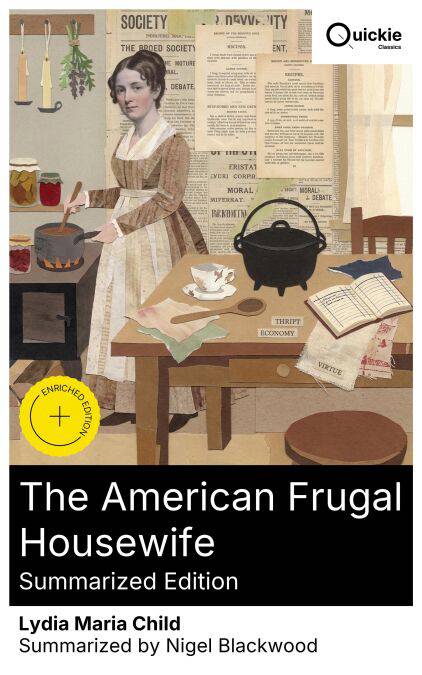
The American Frugal Housewife (Summarized Edition) E-BOOK
Enriched edition. A 19th-century guide to domestic economy: thrift, household management, women's empowerment, social justice, and cooking practices
Lydia Maria Child
E-book | Engels
€ 1,99
+ 1 punten
Omschrijving
The American Frugal Housewife distills early nineteenth-century domestic economy into a compact manual of recipes, household management, and moral counsel. In brisk, imperative prose, Child details economical cookery, repurposing of scraps, preserving, soap and candle making, and plain home remedies, all under the creed that thrift is a civic virtue. Rooted in New England yet national in aim, it answers early republic fears about debt and display with cornmeal porridges, apple vinegar, and careful accounts. Child, born in Massachusetts in 1802, joined literary ambition to reformist purpose: author of Hobomok, editor of the Juvenile Miscellany, and later a prominent abolitionist. Her marriage to David Lee Child brought chronic financial strain, compelling her to make letters support a household. From that lived economy—and Yankee pedagogical habits—she forged a guide for families of modest means, where prudence was both survival strategy and ethical stance. Students of American letters, women's history, and food studies—as well as readers seeking sustainable, budget-wise practice—will value this lucid primary text. Read it critically for period assumptions, and appreciatively for its intelligence, craft, and humane insistence on living within one's means. Few books show so clearly how the household can be a crucible of economy and ethics.
Quickie Classics summarizes timeless works with precision, preserving the author's voice and keeping the prose clear, fast, and readable—distilled, never diluted. Enriched Edition extras: Introduction · Synopsis · Historical Context · Brief Analysis · 4 Reflection Q&As · Editorial Footnotes.
Quickie Classics summarizes timeless works with precision, preserving the author's voice and keeping the prose clear, fast, and readable—distilled, never diluted. Enriched Edition extras: Introduction · Synopsis · Historical Context · Brief Analysis · 4 Reflection Q&As · Editorial Footnotes.
Specificaties
Betrokkenen
- Auteur(s):
- Uitgeverij:
Inhoud
- Aantal bladzijden:
- 73
- Taal:
- Engels
Eigenschappen
- Productcode (EAN):
- 8596547881094
- Verschijningsdatum:
- 09/01/2026
- Uitvoering:
- E-book
- Beveiligd met:
- Digital watermarking
- Formaat:
- ePub


Alleen bij Standaard Boekhandel
+ 1 punten op je klantenkaart van Standaard Boekhandel
Cadeau

AANGERADEN


Beoordelingen
We publiceren alleen reviews die voldoen aan de voorwaarden voor reviews. Bekijk onze voorwaarden voor reviews.