


- Afhalen na 1 uur in een winkel met voorraad
- Gratis thuislevering in België vanaf € 30
- Ruim aanbod met 7 miljoen producten
- Afhalen na 1 uur in een winkel met voorraad
- Gratis thuislevering in België vanaf € 30
- Ruim aanbod met 7 miljoen producten





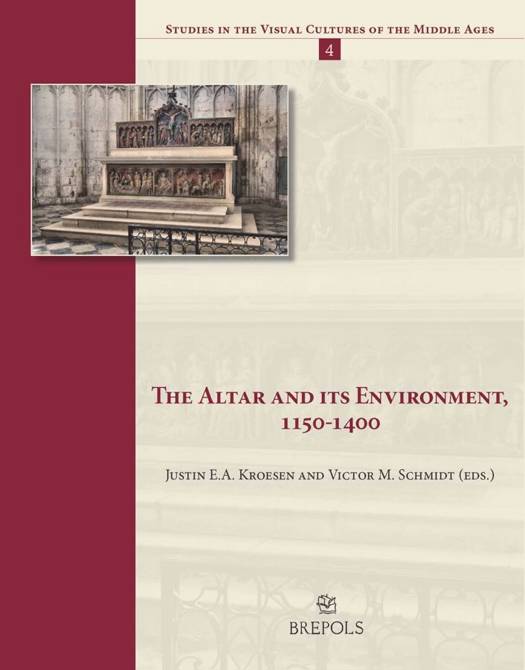
The Altar and its Environment, 1150-1400
Justin E.A. Kroesen
€ 100,70
+ 201 punten
Omschrijving
The articles collected in this volume discuss the rise and spread of the altarpiece, or retable, as the standard altar decoration across Europe during the thirteenth and fourteenth centuries. Historians of art and liturgy have addressed such issues as the relations with other types of altar furnishings, regional variants, and their architectural, liturgical and socio-political context. The papers grew out of a symposium held at the University of Groningen (The Netherlands) in June, 2006, in which fourteen scholars from eight different countries participated. The period under scrutiny, c. 1150-c. 1400, has hitherto received only limited scholarly attention. It starts when the altarpiece was well established and ends with the great regional diversification of object types (such as the polyptych in Italy and the winged altarpiece in northern and central Europe). In turn, the altar decorations studied here are characterized by a relative uniformity stretching across media and regions, which enables comparisons to be made. The objects studied can be found in such diverse locations as Iceland, Sweden, Denmark, Germany, England, the Low Countries, central France, Catalonia, Mallorca, northern and central Italy, and Cyprus. This pan-European scope reveals connections that for many have always gone unnoticed, and contributes to a new perspective on European art that transcends modern national boundaries. The volume is illustrated with a wealth of plates and figures.
Specificaties
Betrokkenen
- Auteur(s):
- Uitgeverij:
Inhoud
- Aantal bladzijden:
- 320
- Taal:
- Frans
- Reeks:
- Reeksnummer:
- nr. 4
Eigenschappen
- Productcode (EAN):
- 9782503530444
- Verschijningsdatum:
- 27/05/2010
- Uitvoering:
- Paperback
- Formaat:
- Trade paperback (VS)
- Afmetingen:
- 221 mm x 279 mm
- Gewicht:
- 1338 g


Alleen bij Standaard Boekhandel
+ 201 punten op je klantenkaart van Standaard Boekhandel
Cadeau

AANGERADEN


Beoordelingen
We publiceren alleen reviews die voldoen aan de voorwaarden voor reviews. Bekijk onze voorwaarden voor reviews.