


- Afhalen na 1 uur in een winkel met voorraad
- Gratis thuislevering in België vanaf € 30
- Ruim aanbod met 7 miljoen producten
- Afhalen na 1 uur in een winkel met voorraad
- Gratis thuislevering in België vanaf € 30
- Ruim aanbod met 7 miljoen producten





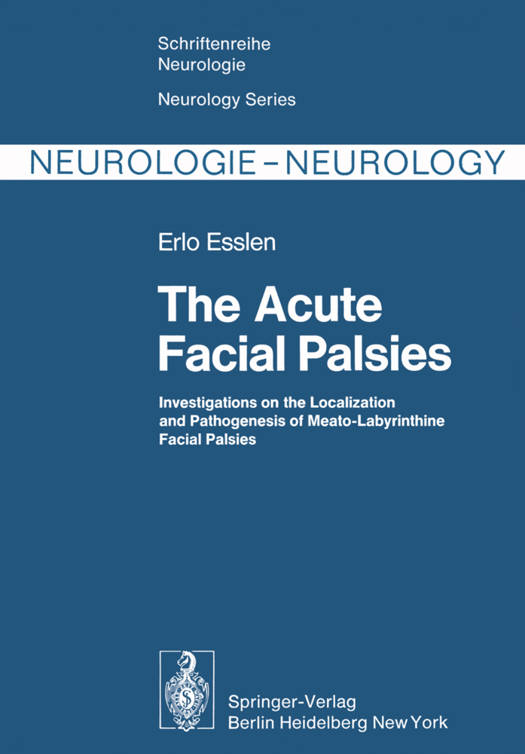
The Acute Facial Palsies
Investigations on the Localization and Pathogenesis of Meato-Labyrinthine Facial Palsies
Erlo Esslen
€ 147,95
+ 295 punten
Omschrijving
I have been privileged to work with Dr. Esslen for more than ten years and to have witnessed howsurgical progress combinedwith accurate clinical and electrophysiological investigations have revolutionized the diagnostic and therapeutic approach to the para- lysed face. The longjourneyofthe VIIth nerve through the temporal bone has been consid- ered for years responsible for the particular liabilityofthis nerve to acute palsies. The disappointing results obtainedwith surgical decompression confined ofnecessity to the mastoid and tympanic segmentsofthe fallopian canalled us in the sixties to apply modern otoneurosurgical techniques in orderto achieve total exposure ofthe intra- temporal course ofthe facial nerve. At that time Esslen started to record with surface electrodes the compound action potential evoked by maximal percutaneous stimulation in representative areas ofthe facial muscles. With this method, called electroneurono- graphy, exact determination ot the percentageofdegenerated nerve fibers could be achieved in the early stagesofthe palsy. Precise electroneuronographic criteria for the selectionofpatients requiring surgery in order possibly to improve the outcome oftheir disfiguring paralysis were worked out. At surgery d ect stimulationofthe totally exposed intratemporal portionofthe facial nerve was used for the first time in combina- tion with electroneurography in order to determine objectively the degree ofthe lesion. In contrast to what hasbeen believed for years the pathology related with acute facial palsy has been found to be situated in the majorityofthe cases at the entrance and not toward the exit ofthe fallopian canal.
Specificaties
Betrokkenen
- Auteur(s):
- Uitgeverij:
Inhoud
- Aantal bladzijden:
- 164
- Taal:
- Engels
- Reeks:
- Reeksnummer:
- nr. 18
Eigenschappen
- Productcode (EAN):
- 9783642665363
- Verschijningsdatum:
- 28/12/2011
- Uitvoering:
- Paperback
- Formaat:
- Trade paperback (VS)
- Afmetingen:
- 170 mm x 244 mm
- Gewicht:
- 299 g


Alleen bij Standaard Boekhandel
+ 295 punten op je klantenkaart van Standaard Boekhandel
Wedstrijd


Beoordelingen
We publiceren alleen reviews die voldoen aan de voorwaarden voor reviews. Bekijk onze voorwaarden voor reviews.