


- Afhalen na 1 uur in een winkel met voorraad
- Gratis thuislevering in België vanaf € 30
- Ruim aanbod met 7 miljoen producten
- Afhalen na 1 uur in een winkel met voorraad
- Gratis thuislevering in België vanaf € 30
- Ruim aanbod met 7 miljoen producten





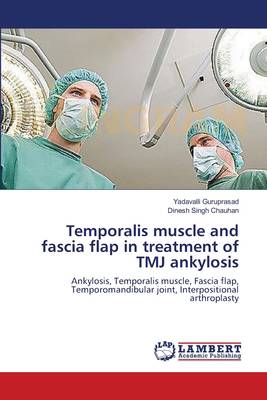
Temporalis muscle and fascia flap in treatment of TMJ ankylosis
Ankylosis, Temporalis muscle, Fascia flap, Temporomandibular joint, Interpositional arthroplasty
Yadavalli Guruprasad, Dinesh Singh Chauhan
Paperback | Engels
€ 57,95
+ 115 punten
Omschrijving
This retrospective study of nine cases of TMJ Ankylosis evaluated the postoperative results of interpositional arthroplasty on temporalis muscle and fascia flap in adults. The operative protocol for unilateral TMJ ankylosis entailed (1) resection of ankylotic mass, (2) intraoral ipsilateral coronoidectomy, (3) contralateral coronoidectomy when necessary, (4) interpositional tissue transfer to the TMJ with temporalis muscle, fascia flap, and (5) early mobilization, aggressive physiotherapy. The study evaluated nine patients with follow-up checks from 13 to 31 months (mean 18.3 months). Patients had a preoperative maximal interincisal opening of 9 19 mm (mean 11.7 mm). During the last follow-up observation after surgery, the patients had a maximal interincisal opening of 35 40 mm (mean 38.3 mm).The results of this protocol were encouraging, the functional results of interpositional arthroplasty on temporalis muscle and fascia flap were also satisfactory. The findings of this study support the use of temporalis muscle and fascia flap in adult patients with unilateral TMJ ankylosis. Early postoperative initial exercise, physiotherapy and strict follow-up play an important role.
Specificaties
Betrokkenen
- Auteur(s):
- Uitgeverij:
Inhoud
- Aantal bladzijden:
- 72
- Taal:
- Engels
Eigenschappen
- Productcode (EAN):
- 9783659161308
- Verschijningsdatum:
- 18/06/2012
- Uitvoering:
- Paperback
- Afmetingen:
- 150 mm x 220 mm
- Gewicht:
- 113 g


Alleen bij Standaard Boekhandel
+ 115 punten op je klantenkaart van Standaard Boekhandel
CADEAU


Beoordelingen
We publiceren alleen reviews die voldoen aan de voorwaarden voor reviews. Bekijk onze voorwaarden voor reviews.