



- Afhalen na 1 uur in een winkel met voorraad
- In januari gratis thuislevering in België
- Ruim aanbod met 7 miljoen producten
- Afhalen na 1 uur in een winkel met voorraad
- In januari gratis thuislevering in België
- Ruim aanbod met 7 miljoen producten





€ 108,45
+ 216 punten
Omschrijving
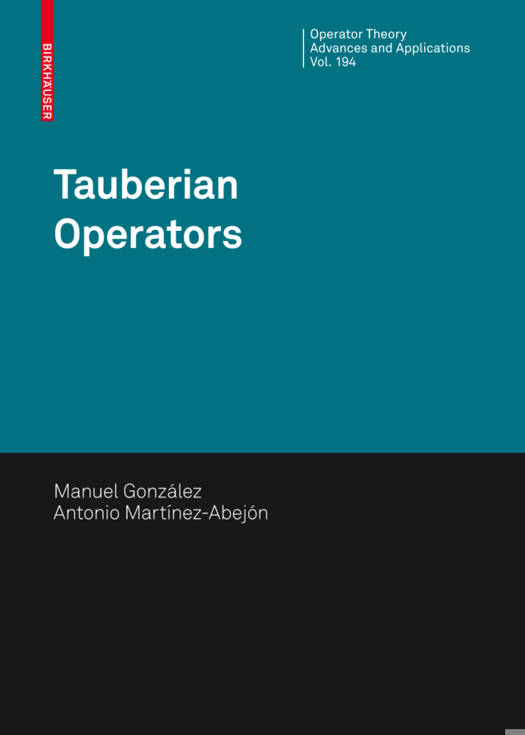
Tauberian operators were introduced to investigate a problem in summability theory from an abstract point of view. Since that introduction, they have made a deep impact on the isomorphic theory of Banach spaces. In fact, these operators havebeen useful in severalcontexts of Banachspacetheory that haveno apparent or obvious connections. For instance, they appear in the famous factorization of Davis, Figiel, Johnson and Pe lczynski [49] (henceforth the DFJP factorization), in the study of exact sequences of Banach spaces [174], in the solution of certain summabilityproblemsoftauberiantype[63,115], intheproblemoftheequivalence between the Krein-Milman property and the Radon-Nikodym property [151], in certain sequels of James characterization of re?exive Banach spaces [135], in the construction of hereditarily indecomposable Banach spaces [13], in the extension of the principle of local re?exivity to operators [27], in the study of certain Calkin algebras associated with the weakly compact operators [16], etc. Since the results concerning tauberian operatorsappear scattered throughout the literature, in this book wegive a uni?ed presentationof their propertiesand their main applications in functional analysis. We also describe some questions about tauberian operators that remain open. This book has six chapters and an appendix. In Chapter 1 we show how the concept of tauberian operator was introduced in the study of a classical problem in summability theory the characterization of conservative matrices that sum no bounded divergent sequences by means of functional analysis techniques. One of thosesolutionsisdue toCrawford[45], whoconsideredthe secondconjugateofthe operatorassociatedwithoneofthosematrices."
Specificaties
Betrokkenen
- Auteur(s):
- Uitgeverij:
Inhoud
- Aantal bladzijden:
- 248
- Taal:
- Engels
- Reeks:
- Reeksnummer:
- nr. 194
Eigenschappen
- Productcode (EAN):
- 9783764389970
- Verschijningsdatum:
- 19/11/2009
- Uitvoering:
- Hardcover
- Formaat:
- Genaaid
- Afmetingen:
- 165 mm x 231 mm
- Gewicht:
- 612 g



Alleen bij Standaard Boekhandel
+ 216 punten op je klantenkaart van Standaard Boekhandel
Cadeau

AANGERADEN


Beoordelingen
We publiceren alleen reviews die voldoen aan de voorwaarden voor reviews. Bekijk onze voorwaarden voor reviews.