


- Afhalen na 1 uur in een winkel met voorraad
- Gratis thuislevering in België vanaf € 30
- Ruim aanbod met 7 miljoen producten
- Afhalen na 1 uur in een winkel met voorraad
- Gratis thuislevering in België vanaf € 30
- Ruim aanbod met 7 miljoen producten





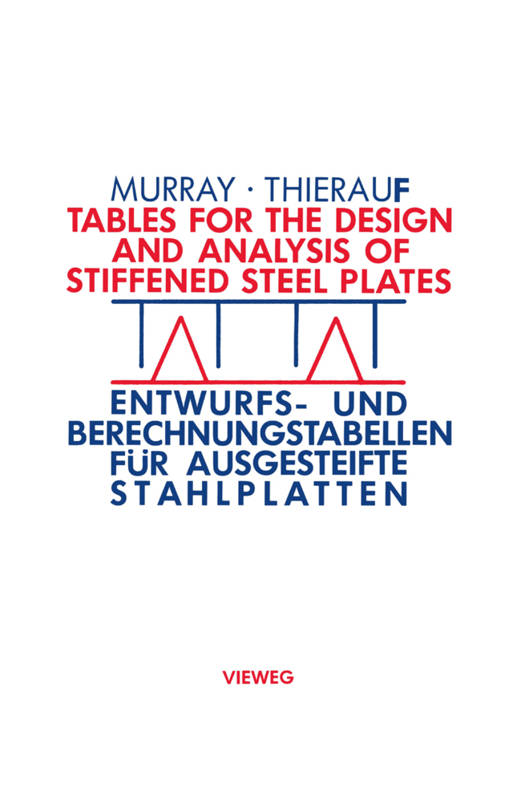
Tables for the Design and Analysis of Stiffened Steel Plates / Entwurfs- Und Berechnungstabellen Für Ausgesteifte Stahlplatten
= Entwurfs- Und Berechnungstabellen Für Ausgesteifte Stahlplatten
Noel W Murray
Paperback | Duits
€ 54,45
+ 108 punten
Omschrijving
Stiffened steel plates have been used for many years especially in the fields of bridges, ships and towers. They are very efficient components of a structure, having both a high strength - to -weight ratio and a pleasing appearance. However, in some cases they have a tendency to buckle in one mode or even two simultaneous modes. In existing codes of practice designers have been supplied with many comprehensive rules so that they can calculate failure loads (collapse conditions) and the loads at which first yield occurs (serviceability conditions). A key calculation in each of these determinations is that which gives the critical stress. However, the critical stress depends upon many features such as the boundary conditions along the sides and at the ends and the geometry of the cross-section. A short stiffened plate may buckle locally whereas a longer panel with the same cross-section may buckle as a wide Euler column. The labour involved in checking individual trial designs is often formidable. It is the aim of this book to try to ease this burden for designers. They will find that it is a simple matter to use this book as if it were a catalogue of sectional properties. Indeed the tables contained herein present the usual section properties but they also indicate the stresses at which local buckling occurs and the panel length beyond which global (i.e. Euler type) buckling governs.
Specificaties
Betrokkenen
- Auteur(s):
- Uitgeverij:
Inhoud
- Aantal bladzijden:
- 197
- Taal:
- Duits
Eigenschappen
- Productcode (EAN):
- 9783528086732
- Verschijningsdatum:
- 1/01/1981
- Uitvoering:
- Paperback
- Formaat:
- Trade paperback (VS)
- Afmetingen:
- 156 mm x 234 mm
- Gewicht:
- 290 g


Alleen bij Standaard Boekhandel
+ 108 punten op je klantenkaart van Standaard Boekhandel
Cadeau

AANGERADEN


Beoordelingen
We publiceren alleen reviews die voldoen aan de voorwaarden voor reviews. Bekijk onze voorwaarden voor reviews.