


- Afhalen na 1 uur in een winkel met voorraad
- Gratis thuislevering in België vanaf € 30
- Ruim aanbod met 7 miljoen producten
- Afhalen na 1 uur in een winkel met voorraad
- Gratis thuislevering in België vanaf € 30
- Ruim aanbod met 7 miljoen producten





Omschrijving
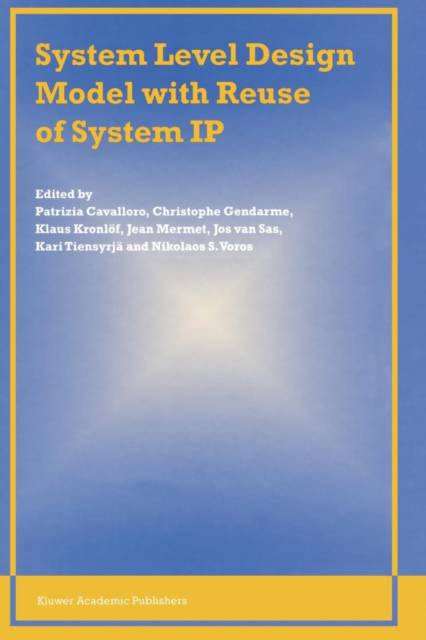
This book presents the perspective of the SYDIC-Telecom project on system design and reuse as perceived in the course of the research during 1999 - 2003. The initial problem statement of the research was formulated as follows: "The current situation regarding system design in general is, that the methods are insufficient, informally practiced, and weakly supported by formal techniques and tools. Regarding system reuse the methods and tools for exchanging system design data and know-how within companies are ad hoc and insufficient. The means available inside companies being already insufficient, there are actually no ways of exchanging between companies. Therefore, there hardly exists any system IP (Intellectual Property) industry. Although system design know-how is one of companies' main assets, it cannot be reused and capitalised effectively enough today. There is a lack of rational design flows supporting a design methodology based on reuse of IP, and few design tools to support it. Even guidelines on how to use existing tools in the design flow for this purpose often do not exist." The problem was known to be hard and the scope broad. The plan of attack was first to analyse the state-of-the-art and the state-of-the-practice, then to identify potential improvements, and finally to synthesise a formalised proposal for implementation. The approach was applied to different system-level issues, e.g. design flows, terminology, languages, reuse, design process and object of design.
Specificaties
Betrokkenen
- Uitgeverij:
Inhoud
- Aantal bladzijden:
- 211
- Taal:
- Engels
Eigenschappen
- Productcode (EAN):
- 9781441953933
- Verschijningsdatum:
- 5/11/2010
- Uitvoering:
- Paperback
- Formaat:
- Trade paperback (VS)
- Afmetingen:
- 156 mm x 234 mm
- Gewicht:
- 317 g

Alleen bij Standaard Boekhandel
+ 318 punten op je klantenkaart van Standaard Boekhandel
CADEAU


Beoordelingen
We publiceren alleen reviews die voldoen aan de voorwaarden voor reviews. Bekijk onze voorwaarden voor reviews.