


- Afhalen na 1 uur in een winkel met voorraad
- Gratis thuislevering in België vanaf € 30
- Ruim aanbod met 7 miljoen producten
- Afhalen na 1 uur in een winkel met voorraad
- Gratis thuislevering in België vanaf € 30
- Ruim aanbod met 7 miljoen producten





€ 76,45
+ 152 punten
Omschrijving
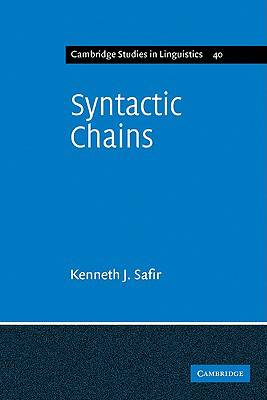
The theory of Government and Binding, developed by Noam Chomsky and his associates, is probably the most striking and promising development in theoretical syntax. In this book Kenneth Safir refines and extends this framework by re-examining the primitive syntactic relations - the means by which all syntactic relationships and interdependencies are defined and expressed with Universal Grammar. Dr Safir proposes the 'Unity of Indexing Hypothesis', which represents a significant constraint on two central concepts in syntactic theory: syntactic chains and the theory of indexing. Syntactic Chains ranges widely across a number of key constructions in syntactic theory, among them impersonal constructions and 'definiteness', the PRO-drop parameter, and Case Theory; and data from an impressive number of European languages are considered. Dr Safir writes lucidly and the technical exposition is always carefully structured. For readers who are unfamiliar with the latest developments in Government and Binding theory his book will provide a valuable introduction to the main principles.
Specificaties
Betrokkenen
- Auteur(s):
- Uitgeverij:
Inhoud
- Aantal bladzijden:
- 412
- Taal:
- Engels
- Reeks:
- Reeksnummer:
- nr. 40
Eigenschappen
- Productcode (EAN):
- 9780521107761
- Verschijningsdatum:
- 5/03/2009
- Uitvoering:
- Paperback
- Formaat:
- Trade paperback (VS)
- Afmetingen:
- 152 mm x 229 mm
- Gewicht:
- 603 g


Alleen bij Standaard Boekhandel
+ 152 punten op je klantenkaart van Standaard Boekhandel
Cadeau

AANGERADEN


Beoordelingen
We publiceren alleen reviews die voldoen aan de voorwaarden voor reviews. Bekijk onze voorwaarden voor reviews.