


- Afhalen na 1 uur in een winkel met voorraad
- Gratis thuislevering in België vanaf € 30
- Ruim aanbod met 7 miljoen producten
- Afhalen na 1 uur in een winkel met voorraad
- Gratis thuislevering in België vanaf € 30
- Ruim aanbod met 7 miljoen producten





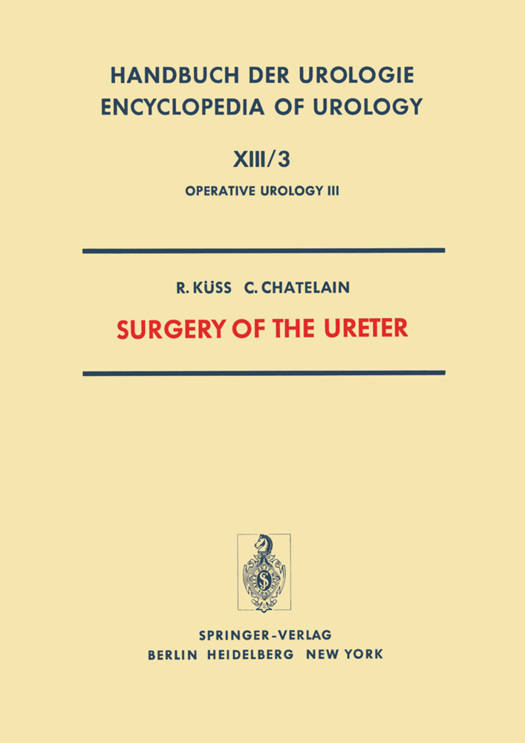
Surgery of the Ureter
R Küss, C Chatelain
Paperback | Engels | Handbuch der Urologie Encyclopedia of Urology Encyclopedie d'Urologie | Operative Urologie / Operative Urology | nr. 13
€ 168,45
+ 336 punten
Omschrijving
There has been great progress in ureteral surgery in the last twenty years. The predominant indication is still calculous obstruction but reparative and plastic surgery of the ureter for congenital and acquired lesions are among the most interesting advances in modern urology. The essential goal of this surgery is to ensure free flow of the urine from the kidney to the bladder and so to preserve or improve kidney function which is always affected or threatened by any defect in the excretory pathway. The ideal is to re-establish a closed circuit flow from kidney to bladder by repair or substitution of the ureteral conduit so as to avoid as far as possible the dis- abilities that result from diversion of the urine to the skin surface or to the intestine. This objective can now be achieved in the treatment of most of the diseases of the ureter when the relevant kidney is sufficiently healthy to merit conserva- tion. The techniques used are not necessarily new but the advent of antibiotics has made it possible to avoid or reduce the risks of infection, pyelonephritis, or pyonephrosis that so often complicated such surgery in earlier times. Progress in the investigation of renal function and of the excretory tract has brought a better understanding of the physio-pathology of the urinary apparatus and more accurate judgement of the results of reparative surgery.
Specificaties
Betrokkenen
- Auteur(s):
- Vertaler(s):
- Uitgeverij:
Inhoud
- Aantal bladzijden:
- 340
- Taal:
- Engels
- Reeks:
- Reeksnummer:
- nr. 13
Eigenschappen
- Productcode (EAN):
- 9783642660818
- Verschijningsdatum:
- 27/12/2011
- Uitvoering:
- Paperback
- Formaat:
- Trade paperback (VS)
- Afmetingen:
- 170 mm x 244 mm
- Gewicht:
- 566 g


Alleen bij Standaard Boekhandel
+ 336 punten op je klantenkaart van Standaard Boekhandel

Beoordelingen
We publiceren alleen reviews die voldoen aan de voorwaarden voor reviews. Bekijk onze voorwaarden voor reviews.