


- Afhalen na 1 uur in een winkel met voorraad
- Gratis thuislevering in België vanaf € 30
- Ruim aanbod met 7 miljoen producten
- Afhalen na 1 uur in een winkel met voorraad
- Gratis thuislevering in België vanaf € 30
- Ruim aanbod met 7 miljoen producten





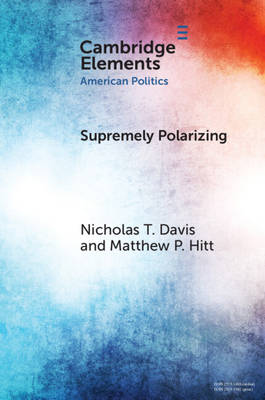
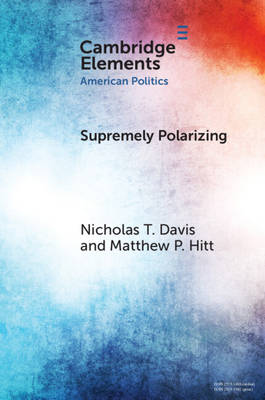
Supremely Polarizing
How Partisanship Structures Support for the Supreme Court
Nicholas T Davis, Matthew P Hitt
€ 36,45
+ 72 punten
Uitvoering
Eenvoudig bestellen
Veilig betalen


Gratis thuislevering vanaf € 30 (via bpost)
Gratis levering in je Standaard Boekhandel
Omschrijving
Although the Supreme Court has historically resisted a partisan sorting out of its public legitimacy, today, Republicans and Democrats look at the Court in very different ways. This Element assembles original survey and experimental data to unpack these changes in three ways. First, the authors illustrate the powerful role that partisanship plays in shaping judicial public opinion. Second, they validate a new three-item measure of specific support and show that it reliably predicts perceptions of Supreme Court legitimacy. Finally, they introduce a new, applied measure of support for the rule of law and connect it to specific and diffuse support. Taken as a whole, their work demonstrates that large chunks of the mass public view the Supreme Court critically. Looking ahead, it is unclear whether legitimacy will rebound when citizens perceive that the balance of judicial power within the nation's High Court has fractured along party lines.
Specificaties
Betrokkenen
- Auteur(s):
- Uitgeverij:
Inhoud
- Aantal bladzijden:
- 96
- Taal:
- Engels
- Reeks:
Eigenschappen
- Productcode (EAN):
- 9781009613453
- Verschijningsdatum:
- 30/04/2026
- Uitvoering:
- Paperback
- Formaat:
- Trade paperback (VS)
- Afmetingen:
- 152 mm x 229 mm
- Gewicht:
- 140 g


Alleen bij Standaard Boekhandel
+ 72 punten op je klantenkaart van Standaard Boekhandel
CADEAU

AANGERADEN


Beoordelingen
We publiceren alleen reviews die voldoen aan de voorwaarden voor reviews. Bekijk onze voorwaarden voor reviews.