Standaard Boekhandel gebruikt cookies en gelijkaardige technologieën om de website goed te laten werken en je een betere surfervaring te bezorgen.
Hieronder kan je kiezen welke cookies je wilt inschakelen:
Technische en functionele cookies
Deze cookies zijn essentieel om de website goed te laten functioneren, en laten je toe om bijvoorbeeld in te loggen. Je kan deze cookies niet uitschakelen.
Analytische cookies
Deze cookies verzamelen anonieme informatie over het gebruik van onze website. Op die manier kunnen we de website beter afstemmen op de behoeften van de gebruikers.
Marketingcookies
Deze cookies delen je gedrag op onze website met externe partijen, zodat je op externe platformen relevantere advertenties van Standaard Boekhandel te zien krijgt.
Bedankt voor het vertrouwen het afgelopen jaar! Om jou te bedanken bieden we GRATIS verzending (in België) aan op alles gedurende de hele maand januari.
Afhalen na 1 uur in een winkel met voorraad
In januari gratis thuislevering in België
Ruim aanbod met 7 miljoen producten
Bedankt voor het vertrouwen het afgelopen jaar! Om jou te bedanken bieden we GRATIS verzending (in België) aan op alles gedurende de hele maand januari.
Je kan maximaal 250 producten tegelijk aan je winkelmandje toevoegen. Verwijdere enkele producten uit je winkelmandje, of splits je bestelling op in meerdere bestellingen.
In januari gratis thuislevering in België (via bpost)
Gratis levering in je Standaard Boekhandel
Omschrijving
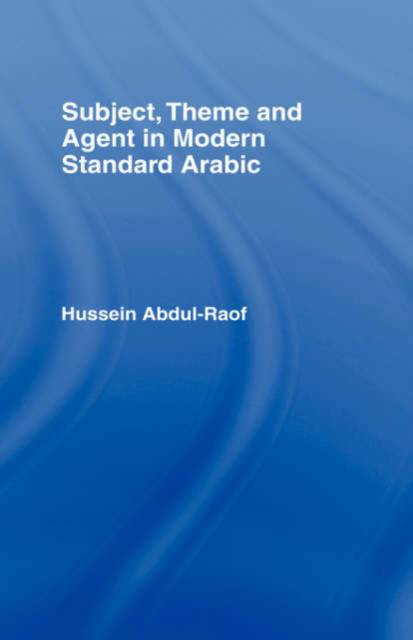
Investigates the universal categories 'subject', 'theme', and 'agent' with special reference to their functional status in Modern Standard Arabic (MSA) and how these three distinct functions may or may not coincide in Arabic sentences. These functions are inexplicitly characterised by classical and modern Arab linguists and Arabists alike. It has been found that the pre- (viz. sentence - initial) or post-verbal noun phrase (NP) in Arabic can be assigned the syntactic function 'subject' but may not necessarily assume the semantic function 'agent', that the pre-verbal NP, which may not necessarily be the 'subject', has the pragmatic function 'theme', and that these distinct functions sometimes cluster around a single NP in certain sentences, depending on genre. It has also been found that in MSA the order of sentence constituents is relatively free, subject to a verb-initial preference, especially when needed to prevent ambiguity. The present study reveals the fact that although coding features such as word order, case marking, and cross-referencing (viz. agreement) may provide a clear indication of which NPs are 'subjects' in MSA, they do not provide a clear-cut indication of semantic relations such as 'agent'; the 'subject' position in MSA is not necessarily the canonical 'agent' position.