



- Afhalen na 1 uur in een winkel met voorraad
- In januari gratis thuislevering in België
- Ruim aanbod met 7 miljoen producten
- Afhalen na 1 uur in een winkel met voorraad
- In januari gratis thuislevering in België
- Ruim aanbod met 7 miljoen producten





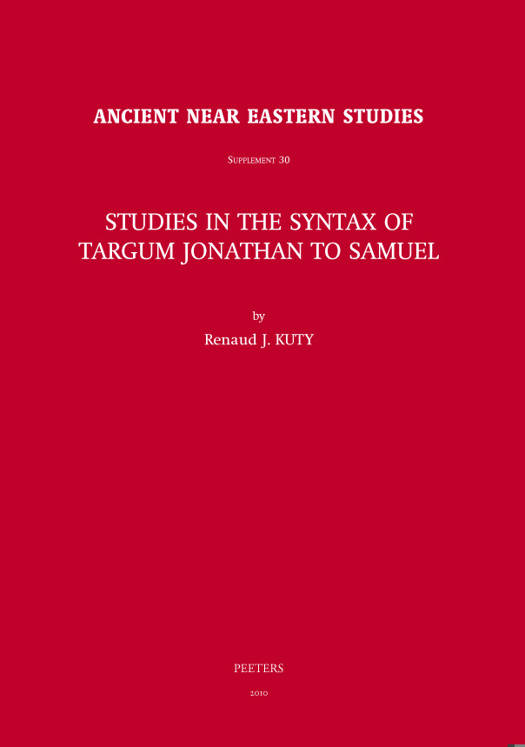
Studies in the Syntax of Targum Jonathan to Samuel
Rj Kuty
€ 85,00
+ 170 punten
Omschrijving
The origin and early history of Targum Onqelos to the Pentateuch and Targum Jonathan to the Prophets have long been the object of lively scholarly discussions. Linguistic arguments have played an important role in the debate, but the grammatical treatment of the Aramaic of these texts has focussed on phonological, orthographical, morphological and lexical matters, leaving syntactic aspects mostly unconsidered. Using the corpus of 1 Samuel and 2 Samuel as a basis, this book investigates five key topics in the syntax of the Aramaic of Targum Jonathan: the use of the states of the noun (determination), the morphosyntax of the numerals, the distribution of the genitive constructions, the verbal system, and word order. It includes a detailed comparative discussion of these syntactic features with reference to other types of Aramaic and attempts to show how the syntax of Targum Jonathan can shed light on the classification of its language within Aramaic as a whole and therefore contribute to our knowledge of its origin and early history.
Specificaties
Betrokkenen
- Auteur(s):
- Uitgeverij:
Inhoud
- Aantal bladzijden:
- 285
- Taal:
- Engels
- Reeks:
- Reeksnummer:
- nr. 30
Eigenschappen
- Productcode (EAN):
- 9789042922112
- Verschijningsdatum:
- 5/07/2010
- Uitvoering:
- Hardcover
- Formaat:
- Genaaid
- Afmetingen:
- 216 mm x 300 mm
- Gewicht:
- 1496 g


Alleen bij Standaard Boekhandel
+ 170 punten op je klantenkaart van Standaard Boekhandel
Cadeau

AANGERADEN


Beoordelingen
We publiceren alleen reviews die voldoen aan de voorwaarden voor reviews. Bekijk onze voorwaarden voor reviews.