


- Afhalen na 1 uur in een winkel met voorraad
- Gratis thuislevering in België vanaf € 30
- Ruim aanbod met 7 miljoen producten
- Afhalen na 1 uur in een winkel met voorraad
- Gratis thuislevering in België vanaf € 30
- Ruim aanbod met 7 miljoen producten





€ 21,45
+ 42 punten
Omschrijving
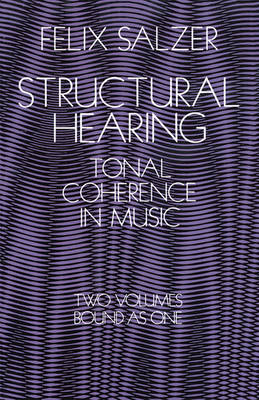
Written by a pupil of the late Heinrich Schenker, this outstanding work is the most thorough exposition in English of Schenker's work. Developing and extending the Schenker approach to include modern music, it explores the phenomenon of tonal organization in Western music by means of a detailed analysis and discussion of more than 500 musical examples ranging in time from the Middle Ages to such moderns as Bartok, Hindemith, Prokofiev, and Stravinsky.
Heinrich Schenker's great contribution was the discovery of fundamental principles of tonal organization, continuity, and coherence. In theory he was the first to define these organic forces of the musical language, particularly the tonal functions and relationships which form both the generative and cohesive forces of great music.Dr. Salzer, in expanding and formulating anew many of Schenker's ideas, has embarked upon a systematic approach. Using the concept of chord functions as a basis, he differentiates sharply between chord grammar (or labeling) and significance, showing that function rather than the ordinary label is really significant. Further distinctions between chords of structure and chords of prolongation, harmonic and contrapuntal uses, and the concept of musical direction provide effective tools for the analysis of music.
This set, which is a standard work used in all important music schools, starts with basic definitions and simple examples, and trains the reader not only to hear successions of tones, melodic lines, and progressions of chords, but also to understand their structural coherence and significance. It is invaluable for musicians and for all who are seriously interested in music, whether as a student, critic, performer, or conductor."Since its publication in 1952 . . . has been the foundation on which all teaching in music theory has been based at this College." -- Leopold Mannes, President, The Mannes College of Music. "Never likely to be improved upon for soundness and comprehensiveness." -- Ernest Newman, The Times. "A thoughtful and provocative contribution to the fields of music theory, aesthetics, and criticism, and performance. Dr. Salzer is to be congratulated on having helped us take a long step out of the Dark Ages." -- Norman Lloyd, Juilliard School of Music, in Notes.
Heinrich Schenker's great contribution was the discovery of fundamental principles of tonal organization, continuity, and coherence. In theory he was the first to define these organic forces of the musical language, particularly the tonal functions and relationships which form both the generative and cohesive forces of great music.Dr. Salzer, in expanding and formulating anew many of Schenker's ideas, has embarked upon a systematic approach. Using the concept of chord functions as a basis, he differentiates sharply between chord grammar (or labeling) and significance, showing that function rather than the ordinary label is really significant. Further distinctions between chords of structure and chords of prolongation, harmonic and contrapuntal uses, and the concept of musical direction provide effective tools for the analysis of music.
This set, which is a standard work used in all important music schools, starts with basic definitions and simple examples, and trains the reader not only to hear successions of tones, melodic lines, and progressions of chords, but also to understand their structural coherence and significance. It is invaluable for musicians and for all who are seriously interested in music, whether as a student, critic, performer, or conductor."Since its publication in 1952 . . . has been the foundation on which all teaching in music theory has been based at this College." -- Leopold Mannes, President, The Mannes College of Music. "Never likely to be improved upon for soundness and comprehensiveness." -- Ernest Newman, The Times. "A thoughtful and provocative contribution to the fields of music theory, aesthetics, and criticism, and performance. Dr. Salzer is to be congratulated on having helped us take a long step out of the Dark Ages." -- Norman Lloyd, Juilliard School of Music, in Notes.
Specificaties
Betrokkenen
- Auteur(s):
- Uitgeverij:
Inhoud
- Aantal bladzijden:
- 688
- Taal:
- Engels
- Reeks:
Eigenschappen
- Productcode (EAN):
- 9780486222752
- Verschijningsdatum:
- 1/06/1962
- Uitvoering:
- Paperback
- Formaat:
- Trade paperback (VS)
- Afmetingen:
- 136 mm x 217 mm
- Gewicht:
- 680 g


Alleen bij Standaard Boekhandel
+ 42 punten op je klantenkaart van Standaard Boekhandel
Cadeau

AANGERADEN


Beoordelingen
We publiceren alleen reviews die voldoen aan de voorwaarden voor reviews. Bekijk onze voorwaarden voor reviews.