


- Afhalen na 1 uur in een winkel met voorraad
- Gratis thuislevering in België vanaf € 30
- Ruim aanbod met 7 miljoen producten
- Afhalen na 1 uur in een winkel met voorraad
- Gratis thuislevering in België vanaf € 30
- Ruim aanbod met 7 miljoen producten





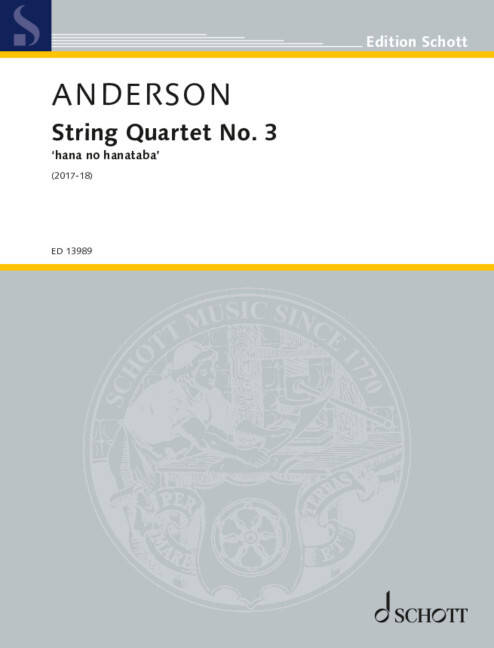
String Quartet No. 3
‘hana no hanataba’. string quartet.
€ 30,00
+ 60 punten
Eenvoudig bestellen
Veilig betalen


Gratis thuislevering vanaf € 30 (via bpost)
Gratis levering in je Standaard Boekhandel
Omschrijving
My 3rd String Quartet is in six contrasted movements. Certain musical figures recur across the work, but there are few themes as such. The main emphasis is on contrast of mood, texture, harmony, pacing and timing. Unlike many of my works this quartet had no extra-musical inspiration, and in principle should have no subtitle. Certain features already present in my music became more prominent in this new work: modes (limited collections of pitches) have always helped me to focus musical character, but here a sense of key note for each mode became much more pronounced, as did the difference between modes for each section of the work. A sort of hybrid key-system emerged (even with equivalents of major and minor) which is not normal tonality, nor does it aim to imitate it. Unlike tonality this key-system includes noises, extended performance techniques and intervals outside Western tuning as available resources. What I hope it does is to focus the listening experience onto different musical areas, to encourage a sense of both modulation from one area to another and to give the music a sense of goal. No conscious knowledge of this is needed when listening: the music should communicate directly on its own.Here, then, is this collection of six musical colours, related and unrelated, different yet belonging together, variable yet in a set order. Hence the subtitle, chosen both for both its sound and its sense: ‘hana no hanataba’ meaning, in Japanese, ‘bouquet of flowers’.A brief description:1)Moderately fast. Short droplets of sounds gather increasing momentum. 2)Very fast. Canons and bells at different speeds.3)Very slow – fast – very slow – very fast – very slow. The main slow movement and its main scherzo. An emphasis on non-tempered tunings and on inhaling and exhaling waves of sound. The slow sections feature florid melodic writing. In the exuberant scherzo competing duos and trios create imaginary folk music.4)Extremely fast/extremely slow. Open strings and harmonics fuse into a single string instrument – like a sort of large resonating Medieval tromba marina.5)Very fast. A variation on movement 2). Variation, Schoenberg told Cage, is just a sort of repetition ‘with some things changed and others not.’6)Slow - Very Fast - Fast – Slow. The opening calm harmonies and florid melodies evoke movement 3) in different music. The fast part features one overt theme: a fanfare-like call to attention which is subject to extensive development. There is much use of non-Western tuning. At its climax the music freezes into a frieze – a wall of sound standing in front of the audience with increasing obstinacy and certainty as the work grinds towards its cadence.
Schwierigkeitsgrad: 5
Schwierigkeitsgrad: 5
Specificaties
Betrokkenen
- Uitgeverij:
Inhoud
- Aantal bladzijden:
- 148
- Reeks:
Eigenschappen
- Productcode (EAN):
- 9790220138089
- Verschijningsdatum:
- 17/07/2024
- Afmetingen:
- 231 mm x 303 mm
- Gewicht:
- 550 g


Alleen bij Standaard Boekhandel
+ 60 punten op je klantenkaart van Standaard Boekhandel
CADEAU

AANGERADEN


Beoordelingen
We publiceren alleen reviews die voldoen aan de voorwaarden voor reviews. Bekijk onze voorwaarden voor reviews.