



- Afhalen na 1 uur in een winkel met voorraad
- In januari gratis thuislevering in België
- Ruim aanbod met 7 miljoen producten
- Afhalen na 1 uur in een winkel met voorraad
- In januari gratis thuislevering in België
- Ruim aanbod met 7 miljoen producten





€ 139,95
+ 279 punten
Omschrijving
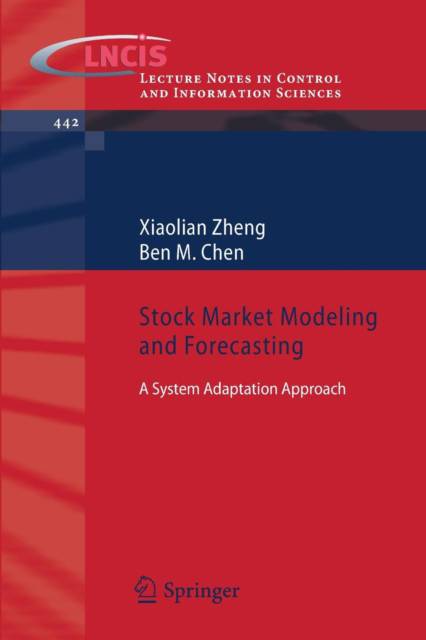
Stock Market Modeling and Forecasting translates experience in system adaptation gained in an engineering context to the modeling of financial markets with a view to improving the capture and understanding of market dynamics. The modeling process is considered as identifying a dynamic system in which a real stock market is treated as an unknown plant and the identification model proposed is tuned by feedback of the matching error. Like a physical system, a financial market exhibits fast and slow dynamics corresponding to external (such as company value and profitability) and internal forces (such as investor sentiment and commodity prices) respectively. The framework presented here, consisting of an internal model and an adaptive filter, is successful at considering both fast and slow market dynamics. A double selection method is efficacious in identifying input factors influential in market movements, revealing them to be both frequency- and market-dependent.
The authors present work on both developed and developing markets in the shape of the US, Hong Kong, Chinese and Singaporean stock markets. Results from all these sources demonstrate the efficiency of the model framework in identifying significant influences and the quality of its predictive ability; promising results are also obtained by applying the model framework to the forecasting of major market-turning periods. Having shown that system-theoretic ideas can form the core of a novel and effective basis for stock market analysis, the book is completed by an indication of possible and likely future expansions of the research in this area.
The authors present work on both developed and developing markets in the shape of the US, Hong Kong, Chinese and Singaporean stock markets. Results from all these sources demonstrate the efficiency of the model framework in identifying significant influences and the quality of its predictive ability; promising results are also obtained by applying the model framework to the forecasting of major market-turning periods. Having shown that system-theoretic ideas can form the core of a novel and effective basis for stock market analysis, the book is completed by an indication of possible and likely future expansions of the research in this area.
Specificaties
Betrokkenen
- Auteur(s):
- Uitgeverij:
Inhoud
- Aantal bladzijden:
- 161
- Taal:
- Engels
- Reeks:
- Reeksnummer:
- nr. 442
Eigenschappen
- Productcode (EAN):
- 9781447151548
- Verschijningsdatum:
- 23/04/2013
- Uitvoering:
- Paperback
- Formaat:
- Trade paperback (VS)
- Afmetingen:
- 152 mm x 229 mm
- Gewicht:
- 272 g


Alleen bij Standaard Boekhandel
+ 279 punten op je klantenkaart van Standaard Boekhandel
Cadeau

AANGERADEN


Beoordelingen
We publiceren alleen reviews die voldoen aan de voorwaarden voor reviews. Bekijk onze voorwaarden voor reviews.