


- Afhalen na 1 uur in een winkel met voorraad
- Gratis thuislevering in België vanaf € 30
- Ruim aanbod met 7 miljoen producten
- Afhalen na 1 uur in een winkel met voorraad
- Gratis thuislevering in België vanaf € 30
- Ruim aanbod met 7 miljoen producten





Omschrijving
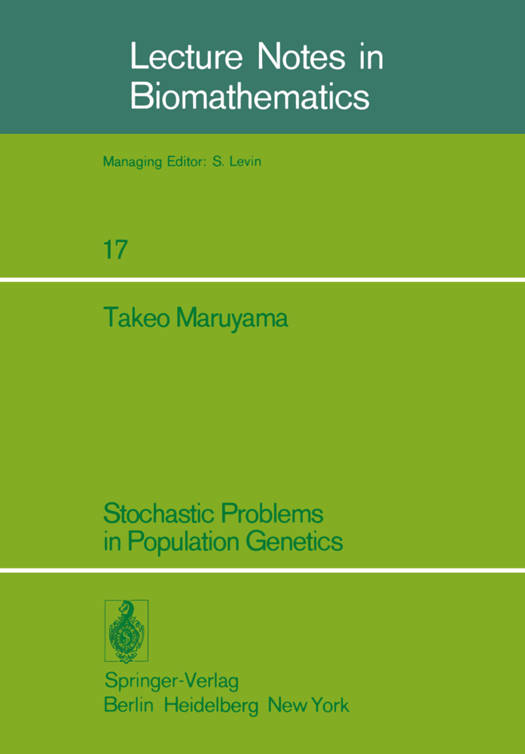
These are" notes based on courses in Theoretical Population Genetics given at the University of Texas at Houston during the winter quarter, 1974, and at the University of Wisconsin during the fall semester, 1976. These notes explore problems of population genetics and evolution involving stochastic processes. Biological models and various mathematical techniques are discussed. Special emphasis is given to the diffusion method and an attempt is made to emphasize the underlying unity of various problems based on the Kolmogorov backward equation. A particular effort was made to make the subject accessible to biology students who are not familiar with stochastic processes. The references are not exhaustive but were chosen to provide a starting point for the reader interested in pursuing the subject further. Acknowledgement I would like to use this opportunity to express my thanks to Drs. J. F. Crow, M. Nei and W. J. Schull for their hospitality during my stays at their universities. I am indebted to Dr. M. Kimura for his continuous encouragement. My thanks also go to the small but resolute groups of.students, visitors and colleagues whose enthusiasm was a great source of encouragement. I am especially obliged to Dr. Martin Curie-Cohen and Dr. Crow for reading a large part eX the manuscript and making many valuable comments. Special gratitude is expressed to Miss Sumiko Imamiya for her patience and endurance and for her efficient preparation of the manuscript.
Specificaties
Betrokkenen
- Auteur(s):
- Uitgeverij:
Inhoud
- Aantal bladzijden:
- 248
- Taal:
- Engels
- Reeks:
- Reeksnummer:
- nr. 17
Eigenschappen
- Productcode (EAN):
- 9783540083498
- Verschijningsdatum:
- 1/08/1977
- Uitvoering:
- Paperback
- Formaat:
- Trade paperback (VS)
- Afmetingen:
- 170 mm x 244 mm
- Gewicht:
- 417 g


Alleen bij Standaard Boekhandel
+ 105 punten op je klantenkaart van Standaard Boekhandel

Beoordelingen
We publiceren alleen reviews die voldoen aan de voorwaarden voor reviews. Bekijk onze voorwaarden voor reviews.