


- Afhalen na 1 uur in een winkel met voorraad
- Gratis thuislevering in België vanaf € 30
- Ruim aanbod met 7 miljoen producten
- Afhalen na 1 uur in een winkel met voorraad
- Gratis thuislevering in België vanaf € 30
- Ruim aanbod met 7 miljoen producten





Omschrijving
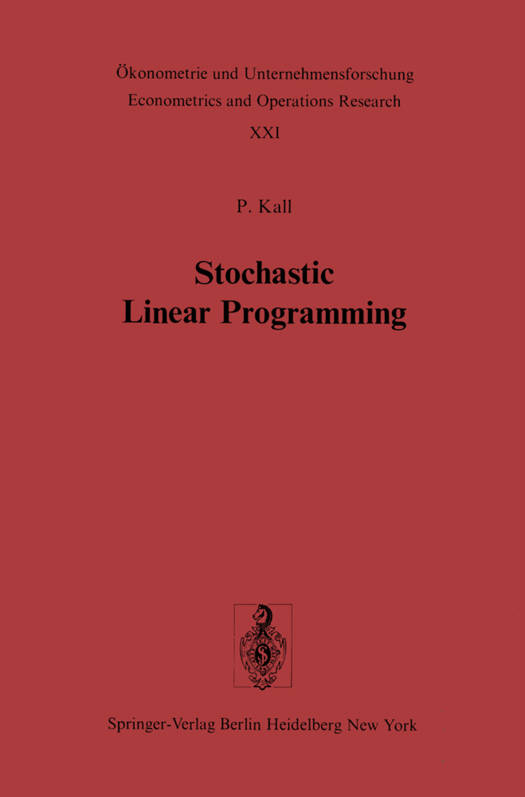
Todaymanyeconomists, engineers and mathematicians are familiar with linear programming and are able to apply it. This is owing to the following facts: during the last 25 years efficient methods have been developed; at the same time sufficient computer capacity became available; finally, in many different fields, linear programs have turned out to be appropriate models for solving practical problems. However, to apply the theory and the methods of linear programming, it is required that the data determining a linear program be fixed known numbers. This condition is not fulfilled in many practical situations, e. g. when the data are demands, technological coefficients, available capacities, cost rates and so on. It may happen that such data are random variables. In this case, it seems to be common practice to replace these random variables by their mean values and solve the resulting linear program. By 1960 various authors had already recog- nized that this approach is unsound: between 1955 and 1960 there were such papers as "Linear Programming under Uncertainty", "Stochastic Linear Pro- gramming with Applications to Agricultural Economics", "Chance Constrained Programming", "Inequalities for Stochastic Linear Programming Problems" and "An Approach to Linear Programming under Uncertainty".
Specificaties
Betrokkenen
- Auteur(s):
- Uitgeverij:
Inhoud
- Aantal bladzijden:
- 96
- Taal:
- Engels
- Reeks:
- Reeksnummer:
- nr. 21
Eigenschappen
- Productcode (EAN):
- 9783642662546
- Verschijningsdatum:
- 7/12/2011
- Uitvoering:
- Paperback
- Formaat:
- Trade paperback (VS)
- Afmetingen:
- 170 mm x 244 mm
- Gewicht:
- 185 g


Alleen bij Standaard Boekhandel
+ 145 punten op je klantenkaart van Standaard Boekhandel

Beoordelingen
We publiceren alleen reviews die voldoen aan de voorwaarden voor reviews. Bekijk onze voorwaarden voor reviews.