


- Afhalen na 1 uur in een winkel met voorraad
- Gratis thuislevering in België vanaf € 30
- Ruim aanbod met 7 miljoen producten
- Afhalen na 1 uur in een winkel met voorraad
- Gratis thuislevering in België vanaf € 30
- Ruim aanbod met 7 miljoen producten





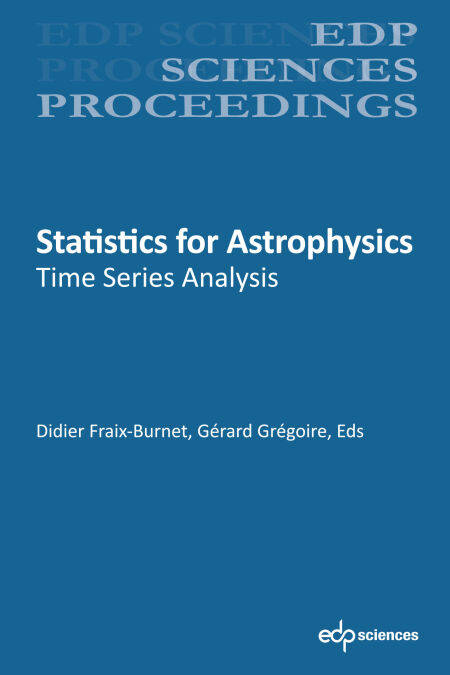
Statistics for astrophysics E-BOOK
Time series analysis
Didier Fraix-Burnet, Gérard Grégoire
E-book | Engels
€ 38,99
+ 38 punten
Eenvoudig bestellen
Veilig betalen


Onmiddellijk geleverd via e-mail
Omschrijving
This book is the result of the 2019 session of the School of Statistics for Astrophysics (Stat4Astro) that took place on October, 6 to 11, 2019, at Autrans near Grenoble, in France. The topic of this fourth session was the time series that, from celestial mechanics to gravitational waves, from exoplanets to quasars, concern nearly all the astrophysics. Variable phenomena are ubiquitous in the Universe: periodic (orbits, cycles, pulses, rotations...), transient (explosions, bursts, stellar activity...), random (accretion, ejection...) or regular (apparent motions...). The detection, the characterization and the classification of these variabilities is a discipline of statistics called time series analysis.
Time series analysis is not new in astrophysics, but has been the subject of major developments in many other disciplines (meteorology, finance, economy, medical sciences...). In this book, you will find lectures from two statisticians who are experts in this field. Gérard Grégoire, who has a long experience in econometrics and made a huge contribution to both this book and the session. He covers the basic elements of classical L2 time series, in the time domain as well as in the frequency domain, for univariate and multivariate series, and provides also tools for statistical inference. He gives an extensive presentation of ARMA and ARIMA series, and addresses some related advanced topics. He also devotes a chapter to linear Gaussian state space models and Kalman filtering that will be helpful to follow the last chapter written by Éric Moulines and collaborators: this final chapter is dedicated to state space models in a general framework and sequential Monte Carlo methods to leverage recursions generalizing the Kalman recursions for filtering and smoothing. Many practical exercises are given using the R environment.
Time series analysis is not new in astrophysics, but has been the subject of major developments in many other disciplines (meteorology, finance, economy, medical sciences...). In this book, you will find lectures from two statisticians who are experts in this field. Gérard Grégoire, who has a long experience in econometrics and made a huge contribution to both this book and the session. He covers the basic elements of classical L2 time series, in the time domain as well as in the frequency domain, for univariate and multivariate series, and provides also tools for statistical inference. He gives an extensive presentation of ARMA and ARIMA series, and addresses some related advanced topics. He also devotes a chapter to linear Gaussian state space models and Kalman filtering that will be helpful to follow the last chapter written by Éric Moulines and collaborators: this final chapter is dedicated to state space models in a general framework and sequential Monte Carlo methods to leverage recursions generalizing the Kalman recursions for filtering and smoothing. Many practical exercises are given using the R environment.
Specificaties
Betrokkenen
- Auteur(s):
- Uitgeverij:
Inhoud
- Aantal bladzijden:
- 258
- Taal:
- Engels
Eigenschappen
- Productcode (EAN):
- 9782759827411
- Verschijningsdatum:
- 14/02/2022
- Uitvoering:
- E-book
- Beveiligd met:
- Digital watermarking
- Formaat:


Alleen bij Standaard Boekhandel
+ 38 punten op je klantenkaart van Standaard Boekhandel
CADEAU

AANGERADEN


Beoordelingen
We publiceren alleen reviews die voldoen aan de voorwaarden voor reviews. Bekijk onze voorwaarden voor reviews.