


- Afhalen na 1 uur in een winkel met voorraad
- Gratis thuislevering in België vanaf € 30
- Ruim aanbod met 7 miljoen producten
- Afhalen na 1 uur in een winkel met voorraad
- Gratis thuislevering in België vanaf € 30
- Ruim aanbod met 7 miljoen producten





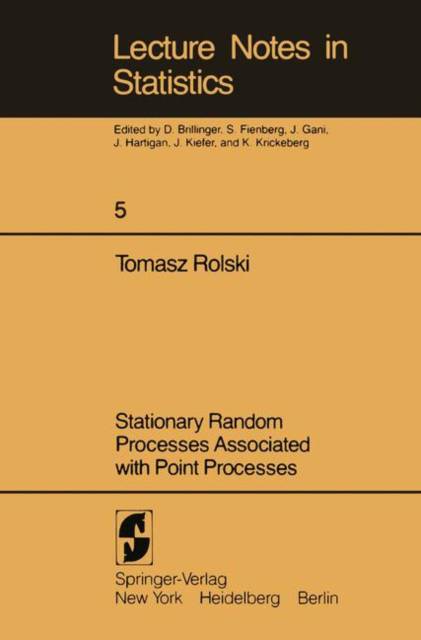
Stationary Random Processes Associated with Point Processes
Tomasz Rolski
€ 106,95
+ 213 punten
Omschrijving
In this set of notes we study a notion of a random process assoc- ted with a point process. The presented theory was inSpired by q- ueing problems. However it seems to be of interest in other branches of applied probability, as for example reliability or dam theory. Using developed tools, we work out known, aswell as new results from queueing or dam theory. Particularly queues which cannot be treated by standard techniques serve as illustrations of the theory. In Chapter 1 the preliminaries are given. We acquaint the reader with the main ideas of these notes, introduce some useful notations, concepts and abbreviations. He also recall basic facts from ergodic theory, an important mathematical tool employed in these notes. Finally some basic notions from queues are reviewed. Chapter 2 deals with discrete time theory. It serves two purposes. The first one is to let the reader get acquainted with the main lines of the theory needed in continuous time without being bothered by tech- nical details. However the discrete time theory also seems to be of interest itself. There are examples which have no counte in continuous time. Chapter 3 deals with continuous time theory. It also contains many basic results from queueing or dam theory. Three applications of the continuous time theory are given in Chapter 4. We show how to use the theory in order to get some useful bounds for the stationary distribution of a random process.
Specificaties
Betrokkenen
- Auteur(s):
- Uitgeverij:
Inhoud
- Aantal bladzijden:
- 139
- Taal:
- Engels
- Reeks:
- Reeksnummer:
- nr. 5
Eigenschappen
- Productcode (EAN):
- 9780387905754
- Verschijningsdatum:
- 21/05/1981
- Uitvoering:
- Paperback
- Formaat:
- Trade paperback (VS)
- Afmetingen:
- 156 mm x 234 mm
- Gewicht:
- 226 g


Alleen bij Standaard Boekhandel
+ 213 punten op je klantenkaart van Standaard Boekhandel
Cadeau

AANGERADEN


Beoordelingen
We publiceren alleen reviews die voldoen aan de voorwaarden voor reviews. Bekijk onze voorwaarden voor reviews.