Standaard Boekhandel gebruikt cookies en gelijkaardige technologieën om de website goed te laten werken en je een betere surfervaring te bezorgen.
Hieronder kan je kiezen welke cookies je wilt inschakelen:
Technische en functionele cookies
Deze cookies zijn essentieel om de website goed te laten functioneren, en laten je toe om bijvoorbeeld in te loggen. Je kan deze cookies niet uitschakelen.
Analytische cookies
Deze cookies verzamelen anonieme informatie over het gebruik van onze website. Op die manier kunnen we de website beter afstemmen op de behoeften van de gebruikers.
Marketingcookies
Deze cookies delen je gedrag op onze website met externe partijen, zodat je op externe platformen relevantere advertenties van Standaard Boekhandel te zien krijgt.
Bedankt voor het vertrouwen het afgelopen jaar! Om jou te bedanken bieden we GRATIS verzending (in België) aan op alles gedurende de hele maand januari.
Afhalen na 1 uur in een winkel met voorraad
In januari gratis thuislevering in België
Ruim aanbod met 7 miljoen producten
Bedankt voor het vertrouwen het afgelopen jaar! Om jou te bedanken bieden we GRATIS verzending (in België) aan op alles gedurende de hele maand januari.
Je kan maximaal 250 producten tegelijk aan je winkelmandje toevoegen. Verwijdere enkele producten uit je winkelmandje, of splits je bestelling op in meerdere bestellingen.
In januari gratis thuislevering in België (via bpost)
Gratis levering in je Standaard Boekhandel
Omschrijving
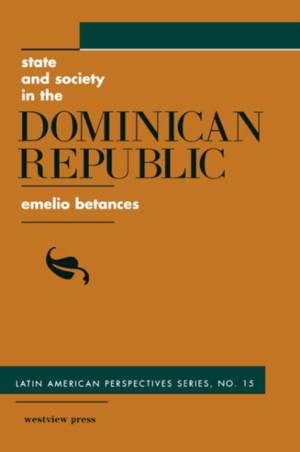
This book offers an analysis of the formation of the Dominican state and explores the development of state-society relations since the late nineteenth century. Emelio Betances argues that the groundwork for the establishment of a modern state was laid during the regimes of Ulises Heureaux and Ram res. The U.S. military government that followed later expanded and strengthened political and administrative centralization. Between 1886 and 1924, these administrations opened the sugar industry to foreign capital investment, integrated Dominican finance into the international credit system, and expanded the role of the military. State expansion, however, was not accompanied by a strengthening of the social and economic base of national elites. Betances suggests that the imbalance between a strong state and a weak civil society provided the structural framework for the emergence in 1930 of the long-lived Trujillo dictatorship.Examining the links between Trujillo and current caudillo Joaqu Balaguer, the author traces continuities and discontinuities in economic and political development through a study of import substitution programs, the reemergence of new economic groups, and the use of the military to counter threats to the status quo. Finally, he explores the impact of foreign intervention and socioeconomic change on the process of state and class formation since 1961.