


- Afhalen na 1 uur in een winkel met voorraad
- Gratis thuislevering in België vanaf € 30
- Ruim aanbod met 7 miljoen producten
- Afhalen na 1 uur in een winkel met voorraad
- Gratis thuislevering in België vanaf € 30
- Ruim aanbod met 7 miljoen producten





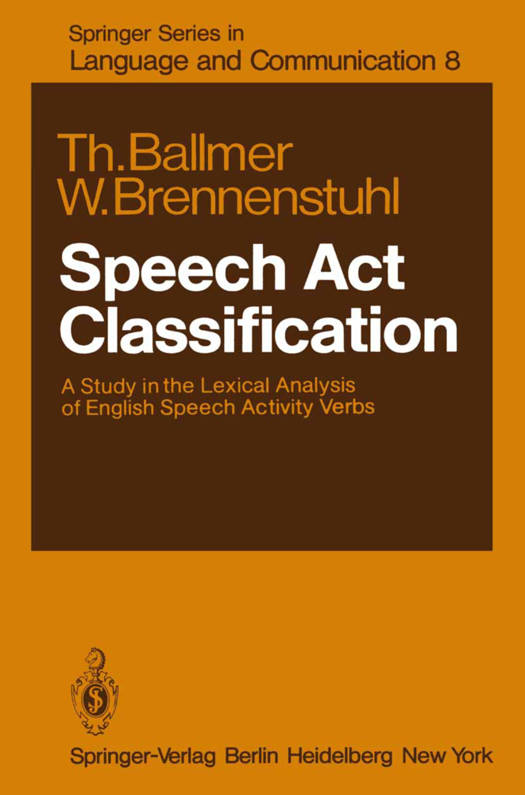
Speech ACT Classification
A Study in the Lexical Analysis of English Speech Activity Verbs
T Ballmer, W Brennstuhl
€ 150,48
+ 300 punten
Omschrijving
This book presents a new classification of speech acts. It is an alter- native to all previously published classifications of speech acts. The classification proposed here is based on an extensive set of data, name- lyon all the verbs designating linguistic activities and aspects thereof. A theoretically and methodologically justifiable method is used to proceed in a number of steps from these data to the classification. The classification is documented in a lexicon with two sections. The first section exhibits the classification in all its details. Each verb is listed to its meaning at the appropriate place in the classification. according The second, alphabetically ordered section enables one to locate the verbs classified in the first part. The speech act classification as presented in this book has a number of consequences for linguistic theorizing: the book makes advances in three linguistically relevant fields - speech act theory, lexicology, and theory of meaning. In speech act theory firstly of course a classifica- tion is proposed which is theoretically justified and which is simul- taneously based explicitly and systematically on linguistic data. Second- ly, a wider concept of speech acts is introduced which proves its value by making possible a linguistically justified classification. Thirdly, the concept of speech act sequence (or more generally partial order) is brought into focus as a major organizational principle of the semantic relation between speech acts.
Specificaties
Betrokkenen
- Auteur(s):
- Uitgeverij:
Inhoud
- Aantal bladzijden:
- 274
- Taal:
- Engels
- Reeks:
- Reeksnummer:
- nr. 8
Eigenschappen
- Productcode (EAN):
- 9783642677601
- Verschijningsdatum:
- 15/11/2011
- Uitvoering:
- Paperback
- Formaat:
- Trade paperback (VS)
- Afmetingen:
- 156 mm x 234 mm
- Gewicht:
- 412 g


Alleen bij Standaard Boekhandel
+ 300 punten op je klantenkaart van Standaard Boekhandel
Wedstrijd


Beoordelingen
We publiceren alleen reviews die voldoen aan de voorwaarden voor reviews. Bekijk onze voorwaarden voor reviews.