


- Afhalen na 1 uur in een winkel met voorraad
- Gratis thuislevering in België vanaf € 30
- Ruim aanbod met 7 miljoen producten
- Afhalen na 1 uur in een winkel met voorraad
- Gratis thuislevering in België vanaf € 30
- Ruim aanbod met 7 miljoen producten





€ 250,45
+ 500 punten
Uitvoering
Omschrijving
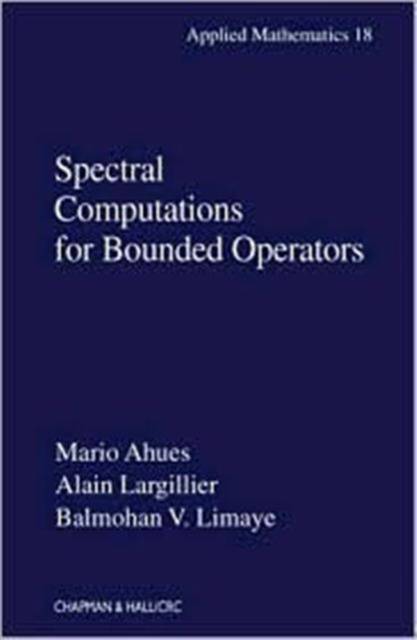
Exact eigenvalues, eigenvectors, and principal vectors of operators with infinite dimensional ranges can rarely be found. Therefore, one must approximate such operators by finite rank operators, then solve the original eigenvalue problem approximately. Serving as both an outstanding text for graduate students and as a source of current results for research scientists, Spectral Computations for Bounded Operators addresses the issue of solving eigenvalue problems for operators on infinite dimensional spaces. From a review of classical spectral theory through concrete approximation techniques to finite dimensional situations that can be implemented on a computer, this volume illustrates the marriage of pure and applied mathematics. It contains a variety of recent developments, including a new type of approximation that encompasses a variety of approximation methods but is simple to verify in practice. It also suggests a new stopping criterion for the QR Method and outlines advances in both the iterative refinement and acceleration techniques for improving the accuracy of approximations. The authors illustrate all definitions and results with elementary examples and include numerous exercises. Spectral Computations for Bounded Operators thus serves as both an outstanding text for second-year graduate students and as a source of current results for research scientists.
Specificaties
Betrokkenen
- Auteur(s):
- Uitgeverij:
Inhoud
- Aantal bladzijden:
- 400
- Taal:
- Engels
- Reeks:
- Reeksnummer:
- nr. 18
Eigenschappen
- Productcode (EAN):
- 9781584881964
- Verschijningsdatum:
- 26/02/2001
- Uitvoering:
- Hardcover
- Formaat:
- Genaaid
- Afmetingen:
- 161 mm x 246 mm
- Gewicht:
- 730 g


Alleen bij Standaard Boekhandel
+ 500 punten op je klantenkaart van Standaard Boekhandel
Cadeau

AANGERADEN


Beoordelingen
We publiceren alleen reviews die voldoen aan de voorwaarden voor reviews. Bekijk onze voorwaarden voor reviews.