



Je cadeautjes zeker op tijd in huis hebben voor de feestdagen? Kom langs in onze winkels en vind het perfecte geschenk!
- Afhalen na 1 uur in een winkel met voorraad
- Gratis thuislevering in België vanaf € 30
- Ruim aanbod met 7 miljoen producten
Je cadeautjes zeker op tijd in huis hebben voor de feestdagen? Kom langs in onze winkels en vind het perfecte geschenk!
- Afhalen na 1 uur in een winkel met voorraad
- Gratis thuislevering in België vanaf € 30
- Ruim aanbod met 7 miljoen producten





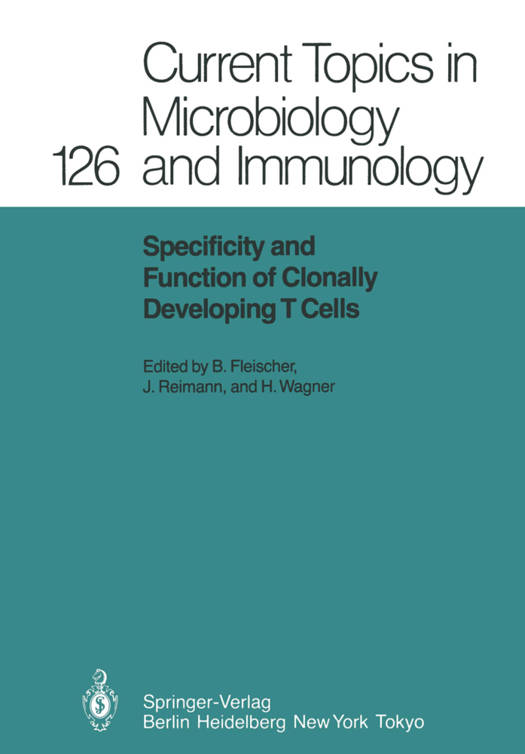
Specificity and Function of Clonally Developing T Cells
€ 150,48
+ 300 punten
Omschrijving
The international workshop on "Specificity and Function of Clonally Developing T Cells" was held at SchloG Rei- sensburg (near UIm, West Germany) on March 17-20, 1985. The meeting brought together immunologists study- ing clonal T-cell development in man and mouse in various in vitro systems at the cellular as well as molecular level. It was an attempt to provide an overview of the current research interests of groups working on (a) the developmen- tal potential of in vitro expanding primary T-cell clones (investigated using limiting dilution analysis) and cloned T -cell lines established in long-term culture; (b) the signals required for the expression of particular patterns of (func- tional and antigen receptor) phenotypes by T cells which are either freshly explanted in vitro, or maintained in vitro as cloned long-term lines; and (c) the generation of an MHC-restricted T-cell repertoire. In the study of thymocytes emphasis has shifted towards the presumably immature adult/embryonic subset(s) which is (are) devoid of subset-specific differentiation markers (L3T4, Lyt-2). Neither the signal requirement(s) for clonal expansion in vitro of these cells, nor their precursor role for any functional T -cell lineage are as yet unambiguously established. The multiple modes of human T-cell activation (e.g., via Tp44, T11, T3/Ti molecular complexes) were em- phasized by a number of presentations and raised the ques- tion of whether these different modes of activation induce different functional activities in individual T-cell clones.
Specificaties
Betrokkenen
- Uitgeverij:
Inhoud
- Aantal bladzijden:
- 316
- Taal:
- Engels
- Reeks:
- Reeksnummer:
- nr. 126
Eigenschappen
- Productcode (EAN):
- 9783642711541
- Verschijningsdatum:
- 17/11/2011
- Uitvoering:
- Paperback
- Formaat:
- Trade paperback (VS)
- Afmetingen:
- 170 mm x 244 mm
- Gewicht:
- 535 g

Alleen bij Standaard Boekhandel
+ 300 punten op je klantenkaart van Standaard Boekhandel
CADEAU


Beoordelingen
We publiceren alleen reviews die voldoen aan de voorwaarden voor reviews. Bekijk onze voorwaarden voor reviews.