


- Afhalen na 1 uur in een winkel met voorraad
- Gratis thuislevering in België vanaf € 30
- Ruim aanbod met 7 miljoen producten
- Afhalen na 1 uur in een winkel met voorraad
- Gratis thuislevering in België vanaf € 30
- Ruim aanbod met 7 miljoen producten





Omschrijving
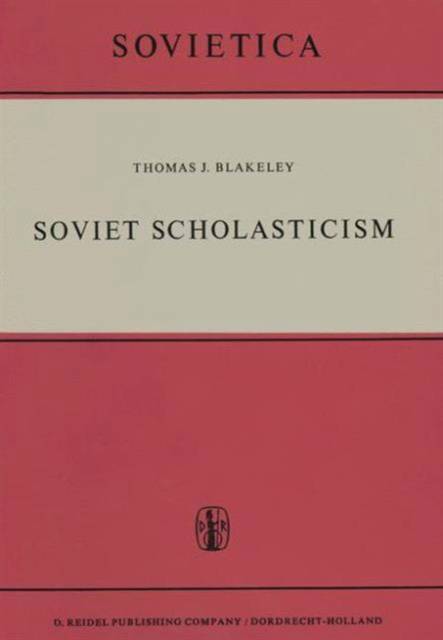
The present work is a study of the method of contemporary Soviet philosophy. By "Soviet philosophy" we mean philosophy as published in the Soviet Union. For practical purposes we have limited our attention to Soviet sources in Russian in spite of the fact that Soviet philosophical works are also published in other languages (see B 2029(21)(38». The term "method" is taken in the sense usual in Western books on methodology .1 In view of the content of the first chapter it will be useful to explain the last term a little more fully. By method we mean a procedure and it is obvious that the principles according to which a procedure is carried out are rules, i.e. imperatives, which tell us not what is but what should be done. Such imperatives mayor may not be connected with and founded on certain descriptive statements (the fact that every rule of formal logic is based on a corresponding law has been well-known since Husserl's "Logische Unter- suchungen" and is generally accepted in contemporary logic), but such a foundation is irrelevant to a methodological study. The object of such a study is to find out what these rules are, why they are accepted and how they are inter-connected and applied. This is how methodology - the science of method - is conceived in Western treatises on the subject and this is also the standpoint assumed here.
Specificaties
Betrokkenen
- Auteur(s):
- Uitgeverij:
Inhoud
- Aantal bladzijden:
- 189
- Taal:
- Engels
- Reeks:
- Reeksnummer:
- nr. 6
Eigenschappen
- Productcode (EAN):
- 9789027700391
- Verschijningsdatum:
- 31/07/1961
- Uitvoering:
- Hardcover
- Formaat:
- Genaaid
- Gewicht:
- 499 g


Alleen bij Standaard Boekhandel
+ 190 punten op je klantenkaart van Standaard Boekhandel
AANGERADEN


Beoordelingen
We publiceren alleen reviews die voldoen aan de voorwaarden voor reviews. Bekijk onze voorwaarden voor reviews.