


- Afhalen na 1 uur in een winkel met voorraad
- Gratis thuislevering in België vanaf € 30
- Ruim aanbod met 7 miljoen producten
- Afhalen na 1 uur in een winkel met voorraad
- Gratis thuislevering in België vanaf € 30
- Ruim aanbod met 7 miljoen producten





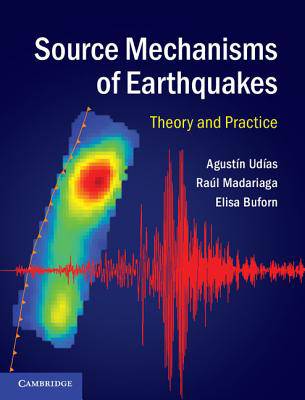
Source Mechanisms of Earthquakes
Theory and Practice
Agustín Udías, Raúl Madariaga, Elisa Buforn
Hardcover | Engels
€ 149,95
+ 299 punten
Omschrijving
This book presents an innovative new approach to studying source mechanisms of earthquakes, combining theory and observation in a unified methodology, with a key focus on the mechanics governing fault failures. It explains source mechanisms by building from fundamental concepts such as the equations of elasticity theory to more advanced problems including dislocation theory, kinematic models and fracture dynamics. The theory is presented first in student-friendly form using consistent notation throughout, and with full, detailed mathematical derivations that enable students to follow each step. Later chapters explain the widely-used practical modelling methods for source mechanism determination, linking clearly to the theoretical foundations, and highlighting the processing of digital seismological data. Providing a unique balance between application techniques and theory, this is an ideal guide for graduate students and researchers in seismology, tectonophysics, geodynamics and geomechanics, and a valuable practical resource for professionals working in seismic hazard assessment and seismic engineering.
Specificaties
Betrokkenen
- Auteur(s):
- Uitgeverij:
Inhoud
- Aantal bladzijden:
- 311
- Taal:
- Engels
Eigenschappen
- Productcode (EAN):
- 9781107040274
- Verschijningsdatum:
- 24/04/2014
- Uitvoering:
- Hardcover
- Formaat:
- Genaaid
- Afmetingen:
- 188 mm x 251 mm
- Gewicht:
- 816 g


Alleen bij Standaard Boekhandel
+ 299 punten op je klantenkaart van Standaard Boekhandel
Cadeau

AANGERADEN


Beoordelingen
We publiceren alleen reviews die voldoen aan de voorwaarden voor reviews. Bekijk onze voorwaarden voor reviews.