


- Afhalen na 1 uur in een winkel met voorraad
- Gratis thuislevering in België vanaf € 30
- Ruim aanbod met 7 miljoen producten
- Afhalen na 1 uur in een winkel met voorraad
- Gratis thuislevering in België vanaf € 30
- Ruim aanbod met 7 miljoen producten





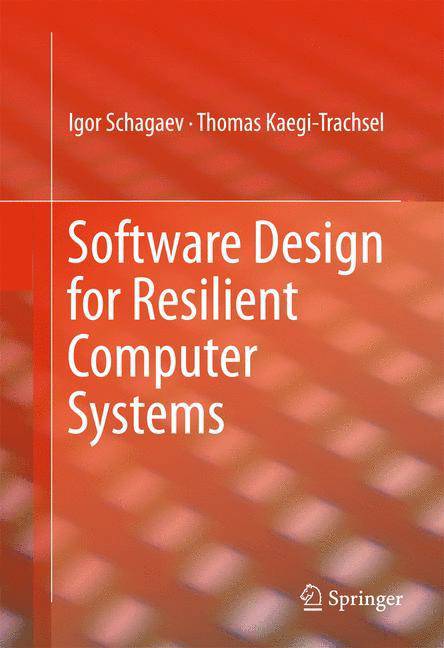
Software Design for Resilient Computer Systems
Igor Schagaev, Thomas Kaegi-Trachsel
Hardcover | Engels
€ 162,45
+ 324 punten
Uitvoering
Omschrijving
This book addresses the question of how system software should be designed to account for faults, and which fault tolerance features it should provide for highest reliability. The authors first show how the system software interacts with the hardware to tolerate faults. They analyze and further develop the theory of fault tolerance to understand the different ways to increase the reliability of a system, with special attention on the role of system software in this process. They further develop the general algorithm of fault tolerance (GAFT) with its three main processes: hardware checking, preparation for recovery, and the recovery procedure. For each of the three processes, they analyze the requirements and properties theoretically and give possible implementation scenarios and system software support required. Based on the theoretical results, the authors derive an Oberon-based programming language with direct support of the three processes of GAFT. In the last part of this book, they introduce a simulator, using it as a proof of concept implementation of a novel fault tolerant processor architecture (ERRIC) and its newly developed runtime system feature-wise and performance-wise. The content applies to industries such as military, aviation, intensive health care, industrial control, space exploration, etc.
Specificaties
Betrokkenen
- Auteur(s):
- Uitgeverij:
Inhoud
- Aantal bladzijden:
- 214
- Taal:
- Engels
Eigenschappen
- Productcode (EAN):
- 9783319294636
- Verschijningsdatum:
- 25/02/2016
- Uitvoering:
- Hardcover
- Afmetingen:
- 160 mm x 241 mm
- Gewicht:
- 494 g


Alleen bij Standaard Boekhandel
+ 324 punten op je klantenkaart van Standaard Boekhandel
Cadeau

AANGERADEN


Beoordelingen
We publiceren alleen reviews die voldoen aan de voorwaarden voor reviews. Bekijk onze voorwaarden voor reviews.