


- Afhalen na 1 uur in een winkel met voorraad
- Gratis thuislevering in België vanaf € 30
- Ruim aanbod met 7 miljoen producten
- Afhalen na 1 uur in een winkel met voorraad
- Gratis thuislevering in België vanaf € 30
- Ruim aanbod met 7 miljoen producten





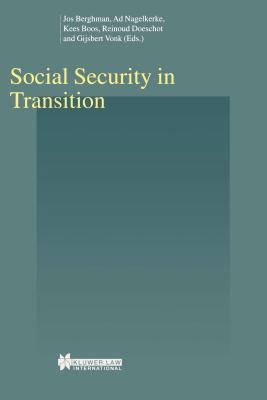
Social Security in Transition
Herbert Feigl
€ 101,04
+ 202 punten
Omschrijving
There was a time when it was clear what risks social security policy was meant to protect: unemployment, sickness, and occupational disability. For many decades, although true equity remained elusive, a focus on these 'external' risks seemed to be enough. It is to the credit of more recent policy that such previously 'hidden' but all-important matters as excluded minorities, inadequate income, and obstacles to personal development are now on the agenda. Yet, with the globalization of the economy, new and unprecedented risks proliferate, most of them being of the 'manufactured' kind that stem from technological and economic factors that are largely independent of time and place and that do not lend themselves easily to regulation. Social Security in Transition surveys and analyses the forces affecting social security policy today as understood by twenty-one, mainly European, authorities in the field. Although each author focuses on specific issues (such as poverty, migration, retirement schemes, access to health care), a consensus emerges that social security can no longer be viewed as a distinct theoretical entity, but that it must be considered in a broad context of social policy that encompasses employment, education, and health care. That the state will remain the last resort for the resolution of dangerous social disparities seems inevitable; yet some transnational standards of fairness (including concerted action for the prevention of and combating the worst evils, such as poverty and social exclusion of migrants) are crucial if we are to develop meaningful state and collective arrangements that will not only support all individuals as they take responsibilities in life, enhance their opportunities, and make meaningful choices, but also safeguard the necessary level of social cohesion in society. Social Security in Transition builds on papers that were originally presented at a June 2001 symposium in The Hague to mark the centenary of the Dutch Occupational Accidents Act 1901 and at the same time of Dutch social security. The symposium was an initiative of the Social Security 2001 Foundation, which was set up by a group of Dutch ministries, administrations and supervisory agencies, and social partners.
Specificaties
Betrokkenen
- Auteur(s):
- Uitgeverij:
Inhoud
- Aantal bladzijden:
- 268
- Taal:
- Engels
- Reeks:
Eigenschappen
- Productcode (EAN):
- 9789041119698
- Verschijningsdatum:
- 18/12/2002
- Uitvoering:
- Hardcover
- Formaat:
- Genaaid
- Afmetingen:
- 157 mm x 244 mm
- Gewicht:
- 571 g


Alleen bij Standaard Boekhandel
+ 202 punten op je klantenkaart van Standaard Boekhandel
Cadeau

AANGERADEN


Beoordelingen
We publiceren alleen reviews die voldoen aan de voorwaarden voor reviews. Bekijk onze voorwaarden voor reviews.