


- Afhalen na 1 uur in een winkel met voorraad
- Gratis thuislevering in België vanaf € 30
- Ruim aanbod met 7 miljoen producten
- Afhalen na 1 uur in een winkel met voorraad
- Gratis thuislevering in België vanaf € 30
- Ruim aanbod met 7 miljoen producten





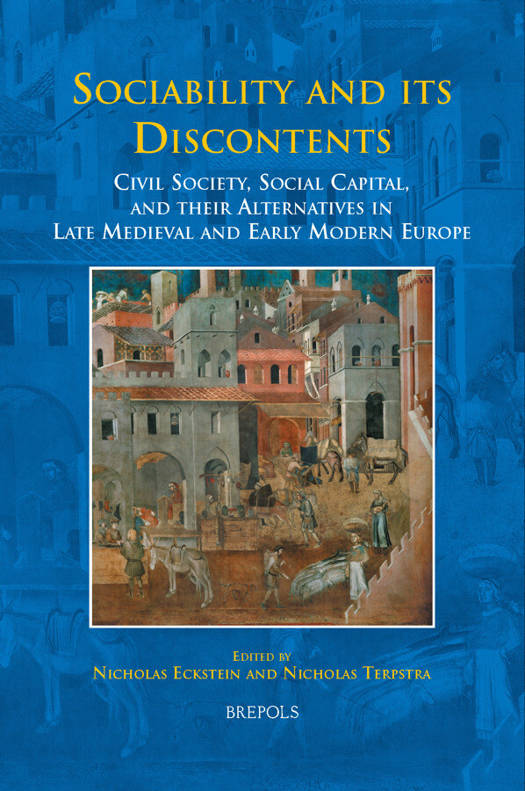
Sociability and Its Discontents
Civil Society, Social Capital, and Their Alternatives in Late Medieval and Early Modern Europe
Nicholas Eckstein
€ 79,50
+ 159 punten
Omschrijving
This volume advances our knowledge of continuing trends over the longue duree of European history. It also exposes many differences separating contemporaries from their medieval and early modern ancestors. In putting the concept of social capital to the test, the authors also expose the strengths, weaknesses, and limits of the 'Putnam thesis'. The essays address fourteenth-century English fears of old-age neglect; childhood, friendship, scandal, and rivalry in Renaissance Florence; rebellion in an Italian village; social capital and seigneurial power in southern and north-central Italy; guild violence in Calvinist Ghent; civil society in early-modern Bologna, Naples and the Papal State; gender in High Renaissance Rome; and critical analyses of the transition from religious to secular sensibilities that scholars (following Jurgen Habermas) have identified in eighteenth-century Europe. In each case, the topic is considered in relation to recent theories of 'social capital': the informal, intangible bonds of trust upon which, social scientist Robert Putnam argues, every human community depends. The result is a series of highly original case-studies which reveal the workings of late medieval and early modern European society from new and often unexpected angles.
Specificaties
Betrokkenen
- Auteur(s):
- Uitgeverij:
Inhoud
- Aantal bladzijden:
- 333
- Taal:
- Engels
- Reeks:
- Reeksnummer:
- nr. 1
Eigenschappen
- Productcode (EAN):
- 9782503524733
- Verschijningsdatum:
- 1/03/2010
- Uitvoering:
- Hardcover
- Formaat:
- Genaaid
- Afmetingen:
- 160 mm x 241 mm
- Gewicht:
- 716 g



Alleen bij Standaard Boekhandel
+ 159 punten op je klantenkaart van Standaard Boekhandel
AANGERADEN


Beoordelingen
We publiceren alleen reviews die voldoen aan de voorwaarden voor reviews. Bekijk onze voorwaarden voor reviews.