


- Afhalen na 1 uur in een winkel met voorraad
- Gratis thuislevering in België vanaf € 30
- Ruim aanbod met 7 miljoen producten
- Afhalen na 1 uur in een winkel met voorraad
- Gratis thuislevering in België vanaf € 30
- Ruim aanbod met 7 miljoen producten




Omschrijving
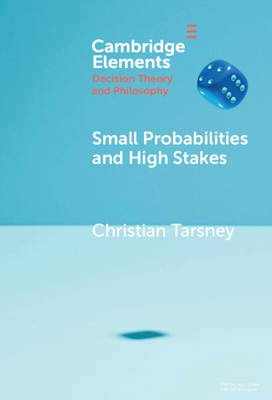
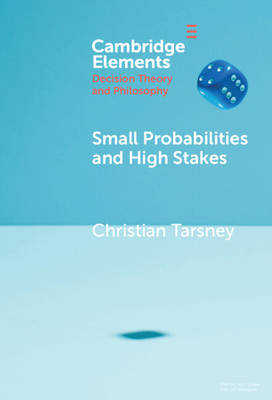
What price should you be willing to pay for a tiny probability of an astronomically large gain, or to avoid a tiny probability of an astronomically large loss? Should you be willing to pay any finite price, if the potential gains or losses are large enough? Fanaticism says you should, while anti-fanaticism says you should not. Focusing on morally motivated decision-making, this Element explores arguments for and against both positions, ultimately defending the intermediate view that rationality permits a range of dispositions toward extreme risks, while ruling out the most comprehensive forms of both fanaticism and anti-fanaticism. The final section considers practical implications, arguing that under real-world circumstances any view satisfying a minimal principle of rationality must very often rank options by expected value, and thus sometimes give great weight to intuitively small probabilities, but that we nonetheless retain rational flexibility in sufficiently extreme cases.
Specificaties
Betrokkenen
- Auteur(s):
- Uitgeverij:
Inhoud
- Aantal bladzijden:
- 75
- Taal:
- Engels
- Reeks:
Eigenschappen
- Productcode (EAN):
- 9781009571609
- Verschijningsdatum:
- 30/04/2026
- Uitvoering:
- Hardcover
- Formaat:
- Genaaid


Alleen bij Standaard Boekhandel
+ 148 punten op je klantenkaart van Standaard Boekhandel
Cadeau

AANGERADEN


Beoordelingen
We publiceren alleen reviews die voldoen aan de voorwaarden voor reviews. Bekijk onze voorwaarden voor reviews.