



Bedankt voor het vertrouwen het afgelopen jaar! Om jou te bedanken bieden we GRATIS verzending (in België) aan op alles gedurende de hele maand januari.
- Afhalen na 1 uur in een winkel met voorraad
- In januari gratis thuislevering in België
- Ruim aanbod met 7 miljoen producten
Bedankt voor het vertrouwen het afgelopen jaar! Om jou te bedanken bieden we GRATIS verzending (in België) aan op alles gedurende de hele maand januari.
- Afhalen na 1 uur in een winkel met voorraad
- In januari gratis thuislevering in België
- Ruim aanbod met 7 miljoen producten





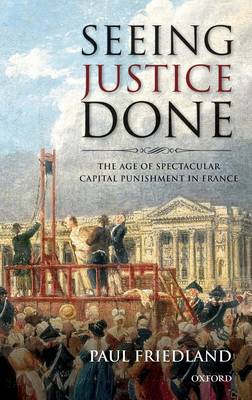
Seeing Justice Done
The Age of Spectacular Capital Punishment in France
Paul Friedland
Hardcover | Engels
€ 157,95
+ 315 punten
Uitvoering
Omschrijving
From the early Middle Ages to the twentieth century, capital punishment in France, as in many other countries, was staged before large crowds of spectators. Paul Friedland traces the theory and practice of public executions over time, both from the perspective of those who staged these punishments as well as from the vantage point of the many thousands who came to 'see justice done'. While penal theorists often stressed that the fundamental purpose of public punishment was to strike fear in the hearts of spectators, the eagerness with which crowds flocked to executions, and the extent to which spectators actually enjoyed the spectacle of suffering suggests that there was a wide gulf between theoretical intentions and actual experiences. Moreover, public executions of animals, effigies, and corpses point to an enduring ritual function that had little to do with exemplary deterrence. In the eighteenth century, when a revolution in sensibilities made it unseemly for individuals to take pleasure in or even witness the suffering of others, capital punishment became the target of reformers. From the invention of the guillotine, which reduced the moment of death to the blink of an eye, to the 1939 decree which moved executions behind prison walls, capital punishment in France was systematically stripped of its spectacular elements.
Partly a history of penal theory, partly an anthropologically-inspired study of the penal ritual, Seeing Justice Done traces the historical roots of modern capital punishment, and sheds light on the fundamental 'disconnect' between the theory and practice of punishment which endures to this day, nit only in France but in the Western penal tradition more generally.
Partly a history of penal theory, partly an anthropologically-inspired study of the penal ritual, Seeing Justice Done traces the historical roots of modern capital punishment, and sheds light on the fundamental 'disconnect' between the theory and practice of punishment which endures to this day, nit only in France but in the Western penal tradition more generally.
Specificaties
Betrokkenen
- Auteur(s):
- Uitgeverij:
Inhoud
- Aantal bladzijden:
- 346
- Taal:
- Engels
Eigenschappen
- Productcode (EAN):
- 9780199592692
- Verschijningsdatum:
- 5/07/2012
- Uitvoering:
- Hardcover
- Formaat:
- Genaaid
- Afmetingen:
- 160 mm x 241 mm
- Gewicht:
- 635 g


Alleen bij Standaard Boekhandel
+ 315 punten op je klantenkaart van Standaard Boekhandel
SOLDEN


Beoordelingen
We publiceren alleen reviews die voldoen aan de voorwaarden voor reviews. Bekijk onze voorwaarden voor reviews.