


- Afhalen na 1 uur in een winkel met voorraad
- Gratis thuislevering in België vanaf € 30
- Ruim aanbod met 7 miljoen producten
- Afhalen na 1 uur in een winkel met voorraad
- Gratis thuislevering in België vanaf € 30
- Ruim aanbod met 7 miljoen producten





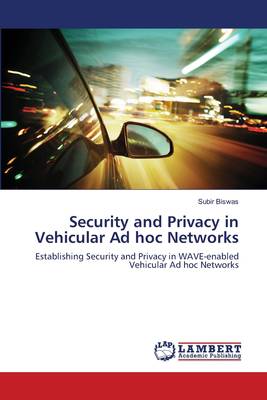
Security and Privacy in Vehicular Ad hoc Networks
Establishing Security and Privacy in WAVE-enabled Vehicular Ad hoc Networks
Subir Biswas
Paperback | Engels
€ 55,45
+ 110 punten
Omschrijving
Security and privacy are among the growing concerns of a Vehicular Ad hoc Network (VANET) which requires a high degree of liability from its participants. In this dissertation, we address security, anonymity, and privacy challenges of VANETs in the light of the IEEE standards for vehicular communications. VANET provides a variety of road-safety and other applications through wireless devices installed in vehicles and roadside infrastructure. However, a vehicle must not be able to take advantage of its anonymity for any misbehavior like sending false messages or malicious updates to other vehicles or a roadside infrastructure. We use proxy signature, identity-based signature, and elliptic curve cryptosystems to provide authentication for infrastructure generated messages, and anonymous authentication for vehicle originated messages. Also, we investigate how some of the MAC-layer weaknesses may impair the security of a VANET. Our solutions are lightweight, bandwidth friendly and compatible to the current standards of vehicular communications.
Specificaties
Betrokkenen
- Auteur(s):
- Uitgeverij:
Inhoud
- Aantal bladzijden:
- 204
- Taal:
- Engels
Eigenschappen
- Productcode (EAN):
- 9783659378676
- Verschijningsdatum:
- 29/04/2013
- Uitvoering:
- Paperback
- Afmetingen:
- 150 mm x 220 mm
- Gewicht:
- 304 g


Alleen bij Standaard Boekhandel
+ 110 punten op je klantenkaart van Standaard Boekhandel
Cadeau

AANGERADEN


Beoordelingen
We publiceren alleen reviews die voldoen aan de voorwaarden voor reviews. Bekijk onze voorwaarden voor reviews.