


- Afhalen na 1 uur in een winkel met voorraad
- Gratis thuislevering in België vanaf € 30
- Ruim aanbod met 7 miljoen producten
- Afhalen na 1 uur in een winkel met voorraad
- Gratis thuislevering in België vanaf € 30
- Ruim aanbod met 7 miljoen producten





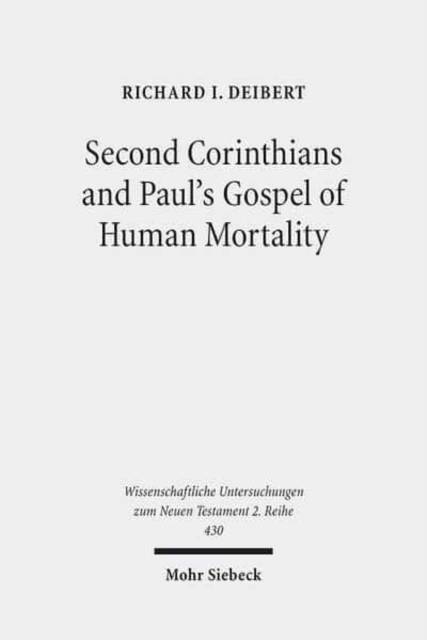
Second Corinthians and Paul's Gospel of Human Mortality
How Paul's Experience of Death Authorizes His Apostolic Authority in Corinth
Richard I Deibert
€ 98,95
+ 197 punten
Eenvoudig bestellen
Veilig betalen


Gratis thuislevering vanaf € 30 (via bpost)
Gratis levering in je Standaard Boekhandel
Omschrijving
In this close reading of Second Corinthians and examination of prevailing attitudes toward death in Greco-Roman Corinth, Richard I. Deibert proposes Paul's physical mortality as the window through which to understand both the mystery of his collapsing authority in Corinth and the heart of his gospel. In his own experience of physical dying, Paul experiences the "deadness" of the resurrected Jesus, which paradoxically communicates life to him and through him to his congregations. Paul discovers that death has been transfigured into a source of life and, consequently, that human mortality has been infused with saving power. This study of human mortality clarifies, both for Paul's day and for our own, how crucial it is to guard the human person as an inseparable unity of body and soul, and to keep theology grounded in experience. Richard I. Deibert's work is of vital interest not only to students of early Christian and New Testament history, but also to students of anthropology, philosophy, and theology.
Specificaties
Betrokkenen
- Auteur(s):
- Uitgeverij:
Inhoud
- Aantal bladzijden:
- 280
- Taal:
- Engels
- Reeks:
- Reeksnummer:
- nr. 430
Eigenschappen
- Productcode (EAN):
- 9783161533778
- Verschijningsdatum:
- 01/01/2017
- Uitvoering:
- Paperback
- Formaat:
- Trade paperback (VS)
- Afmetingen:
- 155 mm x 234 mm
- Gewicht:
- 417 g


Alleen bij Standaard Boekhandel
+ 197 punten op je klantenkaart van Standaard Boekhandel
CADEAU

AANGERADEN


Beoordelingen
We publiceren alleen reviews die voldoen aan de voorwaarden voor reviews. Bekijk onze voorwaarden voor reviews.