



Bedankt voor het vertrouwen het afgelopen jaar! Om jou te bedanken bieden we GRATIS verzending (in België) aan op alles gedurende de hele maand januari.
- Afhalen na 1 uur in een winkel met voorraad
- In januari gratis thuislevering in België
- Ruim aanbod met 7 miljoen producten
Bedankt voor het vertrouwen het afgelopen jaar! Om jou te bedanken bieden we GRATIS verzending (in België) aan op alles gedurende de hele maand januari.
- Afhalen na 1 uur in een winkel met voorraad
- In januari gratis thuislevering in België
- Ruim aanbod met 7 miljoen producten





SCHEPPE W, DONE.BOOK [O/P]
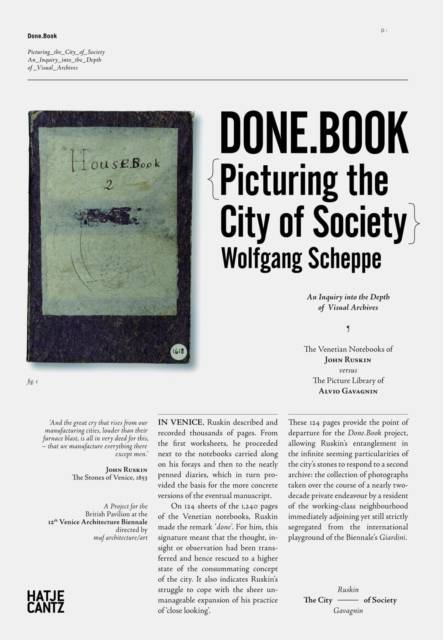
Picturing the City of Society. An Inquiry into the Depth of Visual Archives The Venetian Notebooks of John Ruskin versus the Picture Library of Alvio Gavagnin. Catalogue of the Exhibition in the British Pavilion at the Venice Architecture Biennale, 2010
Wolfgang Scheppe
€ 48,95
+ 97 punten
Omschrijving
In his project Migropolis , Wolfgang Scheppe dealt with Venice as a prototype for the escalation of the globalized city. Now, in this visual study, the German philosopher, who lives and teaches in Venice, has turned to this city yet again for an investigation into the means and scale of representation for the purpose of discovering how its image archives can enable understanding its social character. In this conceptual work, entitled Done.Book, he relates two obsessive attempts at archiving Venice: John Ruskins notebooks and the never-before-seen collection of photographs taken by a resident of the citys working-class district adjacent to the Biennales Giardini. Both evince the conviction that the cognitive quality of the image is a means of acquiring insight, and both also stem from a self-imposed ethical commitment to provide a comprehensive representation of the details of an urban network whose truth can be glimpsed in the minutiae, the hidden details.
Specificaties
Betrokkenen
- Auteur(s):
- Uitgeverij:
Inhoud
- Aantal bladzijden:
- 368
- Taal:
- Engels
Eigenschappen
- Productcode (EAN):
- 9783775727730
- Verschijningsdatum:
- 26/01/2025
- Afmetingen:
- 180 mm x 30 mm
- Gewicht:
- 1250 g



Alleen bij Standaard Boekhandel
+ 97 punten op je klantenkaart van Standaard Boekhandel
SOLDEN


Beoordelingen
We publiceren alleen reviews die voldoen aan de voorwaarden voor reviews. Bekijk onze voorwaarden voor reviews.