


- Afhalen na 1 uur in een winkel met voorraad
- Gratis thuislevering in België vanaf € 30
- Ruim aanbod met 7 miljoen producten
- Afhalen na 1 uur in een winkel met voorraad
- Gratis thuislevering in België vanaf € 30
- Ruim aanbod met 7 miljoen producten





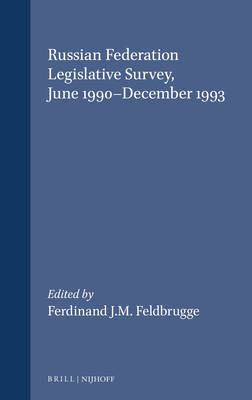
Russian Federation Legislative Survey, June 1990-December 1993
€ 263,95
+ 527 punten
Omschrijving
This special issue of the REVIEW OF CENTRAL AND EAST EUROPEAN LAW compiles the material published under the head `Russian Federation Legislative Survey' in the six 1993 issues of the journal. It covers Russian legislation from the date of the Declaration of the State of Sovereignty of the RSFSR (12 June 1990) until the end of 1992. The principal watershed in this period was the disappearance of the USSR. This event had far-reaching consequences for Russian law, because of the two-tier character of law in the former Soviet Union: USSR law at the top, and underneath the subordinate legal systems of the individual union republics, including the RSFSR. These consequences can still be felt in many areas, and it will take considerable time and major efforts to replace all USSR law by new Russian enactments.
The Institute of East European Law and Russian Studies intends to bring this survey up to date as soon as possible. This is of course desirable for the practitioner, as well as for the academic user. It is felt, however, that it was imperative to build on a solid foundation, even if it meant some delay in the beginning. As new official sources of legislation emerge, as some already have in 1993, they will be included in the issues of the REVIEW OF CENTRAL AND EAST EUROPEAN LAW. The present survey is a reprint of the fourth issue of the REVIEW OF CENTRAL AND EAST EUROPEAN LAW (1994) and is available gratis to subscribers.
The Institute of East European Law and Russian Studies intends to bring this survey up to date as soon as possible. This is of course desirable for the practitioner, as well as for the academic user. It is felt, however, that it was imperative to build on a solid foundation, even if it meant some delay in the beginning. As new official sources of legislation emerge, as some already have in 1993, they will be included in the issues of the REVIEW OF CENTRAL AND EAST EUROPEAN LAW. The present survey is a reprint of the fourth issue of the REVIEW OF CENTRAL AND EAST EUROPEAN LAW (1994) and is available gratis to subscribers.
Specificaties
Betrokkenen
- Uitgeverij:
Inhoud
- Aantal bladzijden:
- 280
- Taal:
- Engels
- Reeks:
- Reeksnummer:
- nr. 7
Eigenschappen
- Productcode (EAN):
- 9780792332435
- Verschijningsdatum:
- 1/02/1995
- Uitvoering:
- Paperback
- Formaat:
- Trade paperback (VS)
- Afmetingen:
- 157 mm x 239 mm
- Gewicht:
- 439 g

Alleen bij Standaard Boekhandel
+ 527 punten op je klantenkaart van Standaard Boekhandel
Cadeau

AANGERADEN


Beoordelingen
We publiceren alleen reviews die voldoen aan de voorwaarden voor reviews. Bekijk onze voorwaarden voor reviews.