


- Afhalen na 1 uur in een winkel met voorraad
- Gratis thuislevering in België vanaf € 30
- Ruim aanbod met 7 miljoen producten
- Afhalen na 1 uur in een winkel met voorraad
- Gratis thuislevering in België vanaf € 30
- Ruim aanbod met 7 miljoen producten





€ 66,00
+ 132 punten
Omschrijving
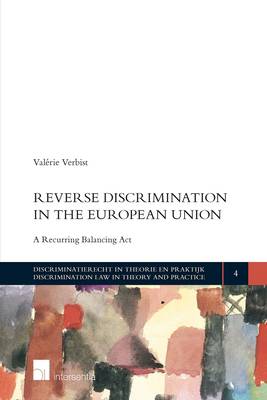
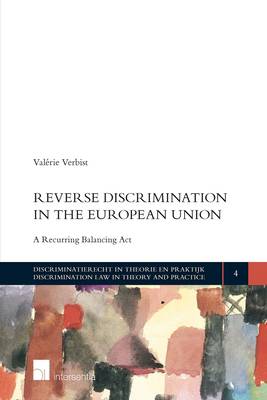
The issue of 'reverse discrimination' is a topical subject, particularly in the field of family reunification. Reverse discrimination occurs when a European Union (EU) citizen in a 'purely internal situation' is treated less favourably than an EU citizen of another nationality whose situation is largely governed by EU law. Reverse Discrimination in the European Union offers an up-to-date standard reference work on reverse discrimination. Part I of this book analyses the issue of reverse discrimination from an EU perspective. In particular, it questions whether reverse discrimination falls within the scope of application of Member State law or whether it falls within the ambit of EU law. Subsequently, it discusses the interpretation of the 'purely internal situation' doctrine on the basis of the case law of the European Court of Justice, giving special attention to recent developments since the controversial Ruiz Zambrano judgment.Although reverse discrimination is of interest from the perspective of the Member States, it is still mostly studied from the viewpoint of the EU. To address this, Part II looks at reverse discrimination in five Member States, namely Belgium, France, Italy, Germany and Austria. The focus lies on the ground(s) on which the national authorities decide whether or not to allow stricter treatment of purely internal situations. Finally, Part III analyses specific instances of reverse discrimination in federally structured Member States, from the perspective of both EU law and Belgian and German law.
Specificaties
Betrokkenen
- Auteur(s):
- Uitgeverij:
Inhoud
- Aantal bladzijden:
- 358
- Taal:
- Engels
- Reeks:
- Reeksnummer:
- nr. 4
Eigenschappen
- Productcode (EAN):
- 9781780684581
- Verschijningsdatum:
- 15/06/2017
- Uitvoering:
- Paperback
- Formaat:
- Trade paperback (VS)
- Afmetingen:
- 160 mm x 240 mm
- Gewicht:
- 644 g


Alleen bij Standaard Boekhandel
+ 132 punten op je klantenkaart van Standaard Boekhandel
CADEAU

AANGERADEN


Beoordelingen
We publiceren alleen reviews die voldoen aan de voorwaarden voor reviews. Bekijk onze voorwaarden voor reviews.