



Bedankt voor het vertrouwen het afgelopen jaar! Om jou te bedanken bieden we GRATIS verzending (in België) aan op alles gedurende de hele maand januari.
- Afhalen na 1 uur in een winkel met voorraad
- In januari gratis thuislevering in België
- Ruim aanbod met 7 miljoen producten
Bedankt voor het vertrouwen het afgelopen jaar! Om jou te bedanken bieden we GRATIS verzending (in België) aan op alles gedurende de hele maand januari.
- Afhalen na 1 uur in een winkel met voorraad
- In januari gratis thuislevering in België
- Ruim aanbod met 7 miljoen producten





Omschrijving
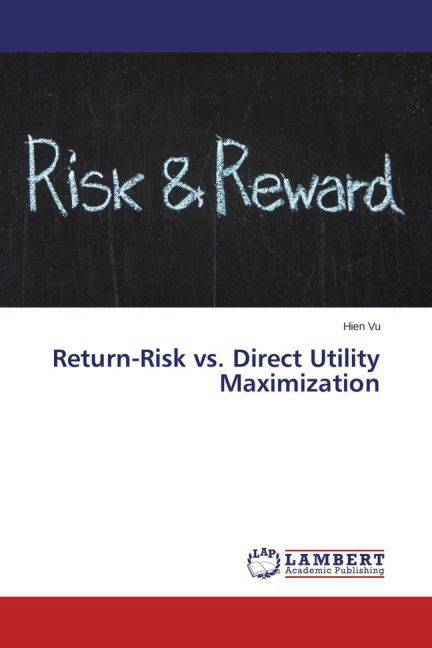
Mean-Risk portfolio optimization method proposes an efficient frontier that consists of portfolios not dominated by any portfolio. Consequently, this method reduces the choice set by excluding inefficient portfolios. Different risk measures offer different efficient frontiers, which can be interpreted as different optimal choice sets. The question is whether these different risk measures lead to significantly different efficient frontiers for the investors, and which risk measure should be used. My purpose is to present a method to assess the effect of the choice set reduction from different Return-Risk models and to answer the question presented earlier. The most important contribution of the paper is the creation of a two-dimensional space "Risk- Aversion - Certainty Equivalence (CE)" as a platform for comparisons. The curves, representing different risk-averse investors and different models, on this space are called "Certainty Equivalence Curves (CEC)". The empirical analysis shows that the Mean-Variance method is very effective in ranking portfolios for exponential utility investors. Therefore, it is not recommended to use more complicated methods such as Mean-CVaR.
Specificaties
Betrokkenen
- Auteur(s):
- Uitgeverij:
Inhoud
- Aantal bladzijden:
- 52
- Taal:
- Engels
Eigenschappen
- Productcode (EAN):
- 9783659758393
- Verschijningsdatum:
- 21/07/2015
- Uitvoering:
- Paperback
- Afmetingen:
- 150 mm x 220 mm
- Gewicht:
- 91 g


Alleen bij Standaard Boekhandel
+ 79 punten op je klantenkaart van Standaard Boekhandel
SOLDEN


Beoordelingen
We publiceren alleen reviews die voldoen aan de voorwaarden voor reviews. Bekijk onze voorwaarden voor reviews.