


- Afhalen na 1 uur in een winkel met voorraad
- Gratis thuislevering in België vanaf € 30
- Ruim aanbod met 7 miljoen producten
- Afhalen na 1 uur in een winkel met voorraad
- Gratis thuislevering in België vanaf € 30
- Ruim aanbod met 7 miljoen producten





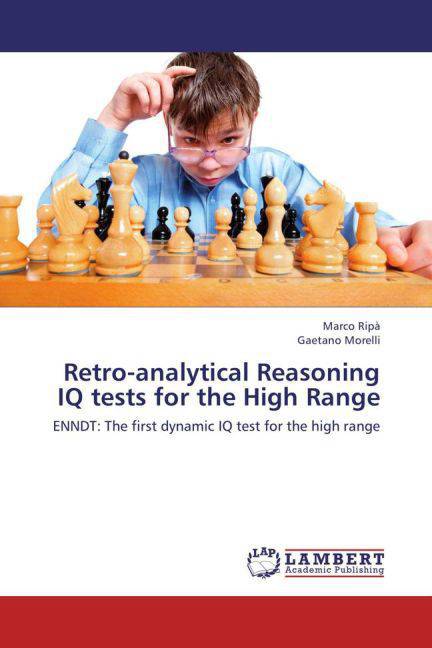
Retro-analytical Reasoning IQ tests for the High Range
ENNDT: The first dynamic IQ test for the high range
Marco Ripà, Gaetano Morelli
Paperback | Engels
€ 32,45
+ 64 punten
Omschrijving
A proposal to produce a new, computer-based generation of IQ tests for the high range without being prone to cheating. IQ tests are at a considerable risk of this kind, and episodes of cheating have actually occurred, even on the most famous standardized and supervised IQ tests. As soon as a test is administered to a candidate, there is no longer the certainty that its items will remain secret; this is as a consequence of the static nature of IQ tests, and the problem may be solved through a dynamic system based on different items for each submission of the test. This proposal is based on a method to construct new integer sequences starting from a given and explicit set of sequences, using information asymmetry (which means different items for each session). The related solving of problems will be linked to inference and retro-analytical reasoning, similar to the retrograde analysis of chess problems.
Specificaties
Betrokkenen
- Auteur(s):
- Uitgeverij:
Inhoud
- Aantal bladzijden:
- 112
- Taal:
- Engels
Eigenschappen
- Productcode (EAN):
- 9783659437649
- Verschijningsdatum:
- 19/07/2013
- Uitvoering:
- Paperback
- Afmetingen:
- 150 mm x 220 mm
- Gewicht:
- 177 g


Alleen bij Standaard Boekhandel
+ 64 punten op je klantenkaart van Standaard Boekhandel
Cadeau

AANGERADEN


Beoordelingen
We publiceren alleen reviews die voldoen aan de voorwaarden voor reviews. Bekijk onze voorwaarden voor reviews.