


- Afhalen na 1 uur in een winkel met voorraad
- Gratis thuislevering in België vanaf € 30
- Ruim aanbod met 7 miljoen producten
- Afhalen na 1 uur in een winkel met voorraad
- Gratis thuislevering in België vanaf € 30
- Ruim aanbod met 7 miljoen producten


Omschrijving
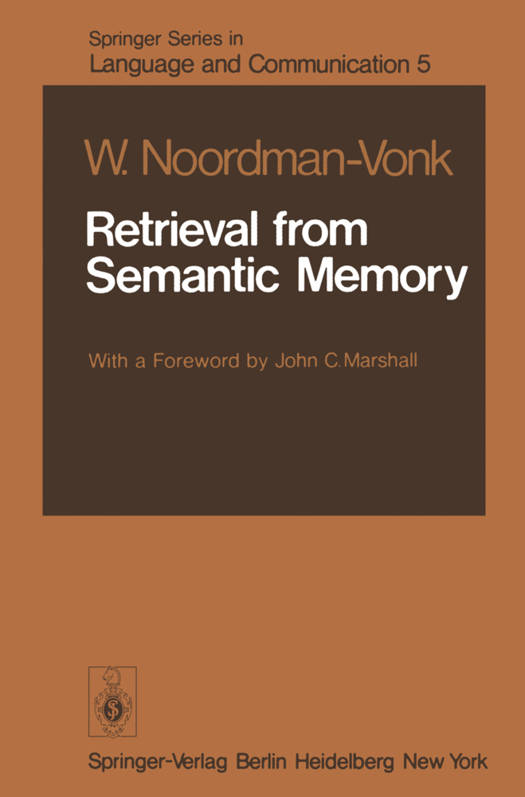
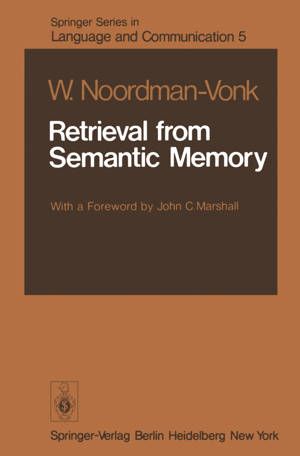
The area of concern to Dr. Wietske Noordman Vonk has been variously seen as an aspect of long-term memory [F. I], secondary memory [F. 2], memory without record [F. 3], and semantic memory [F. 4J, the latter term being the one pre- ferred by Dr. Noordman-Vonk herself. This proliferation of terminology is not an entirely trivial matter, for although the expressions clearly overlap in range, they do draw attention to different features of the phenomena under consideration. The work reported here is concerned with the form of representation and manipulation of our knowledge that, for example, a dog is an animal, or that mothers and daughters are parents and children. To put it more generally, the experiments attempt to elucidate the psychological processes involved in the emantics of class-inclusion and, most importantly, to extend the explanatory principles there invoked to a new domain, that of kinship relations. Clearly, the connections between "ant" and "insect", or "flower" and "plant" have been known to us - as adults - for some considerable period of time; in the absence of brain injury or degeneration we are unlikely to "forget" that fathers and sons are kin of the same sex. We may therefor- pretheoretically - distinguish between retrieval of such knowledge and. re- trieval of a rapidly fading sequence of random numbers that we are asked to recall after a single presentation. It is in this sense that the current work is concerned with long-term and not short-term memory.
Specificaties
Betrokkenen
- Auteur(s):
- Uitgeverij:
Inhoud
- Aantal bladzijden:
- 100
- Taal:
- Engels
- Reeks:
- Reeksnummer:
- nr. 5
Eigenschappen
- Productcode (EAN):
- 9783642672170
- Verschijningsdatum:
- 18/10/2011
- Uitvoering:
- Paperback
- Formaat:
- Trade paperback (VS)
- Afmetingen:
- 156 mm x 234 mm
- Gewicht:
- 172 g


Alleen bij Standaard Boekhandel
+ 263 punten op je klantenkaart van Standaard Boekhandel
Wedstrijd


Beoordelingen
We publiceren alleen reviews die voldoen aan de voorwaarden voor reviews. Bekijk onze voorwaarden voor reviews.