


- Afhalen na 1 uur in een winkel met voorraad
- Gratis thuislevering in België vanaf € 30
- Ruim aanbod met 7 miljoen producten
- Afhalen na 1 uur in een winkel met voorraad
- Gratis thuislevering in België vanaf € 30
- Ruim aanbod met 7 miljoen producten





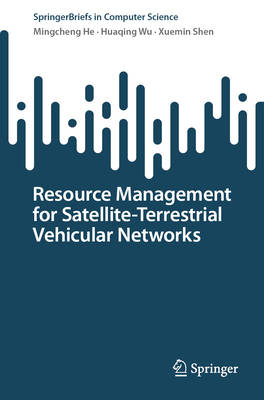
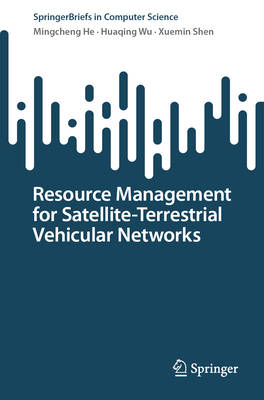
Resource Management for Satellite-Terrestrial Vehicular Networks
Mingcheng He, Huaqing Wu, Xuemin Shen
€ 54,45
+ 108 punten
Omschrijving
This book introduces state-of-the-art research on Satellite-Terrestrial Vehicular Networks (STVNs). It develops theoretical models for performance analysis, evaluating the joint impact of constellation parameters, satellite mobility and terrestrial deployments. Building upon these foundations, this book explores multi-dimensional resource management across satellite and terrestrial networks. Under the slicing-based two-stage framework, adaptive resource slicing for high-definition map distribution and cooperative resource scheduling for environment sensing are presented. This book also provides valuable theoretical foundations and practical insights for the design and optimization of future STVNs. Satellite-Terrestrial Vehicular Networks STVNs, which integrate low Earth orbit (LEO) satellites to supplement terrestrial vehicular networks and offers a heterogeneous architecture to extend network coverage for connected vehicles (CVs). Leveraging vehicle-to-everything (V2X) communication, STVNs can support multifarious safety- and efficiency-oriented applications to expand situational awareness, reduce response time and smooth traffic flow. To meet stringent requirements for network continuity, low latency, and high service reliability under dynamic environments, this book systematically explores resource management for STVNs. It conducts theoretical models for performance analysis and developing multi-dimensional resource management schemes to enable reliable, low-complexity, and adaptive service provisioning for CVs. This book serves as a useful reference for researchers and engineers in the fields of vehicular networks and integration of satellite-terrestrial networks to help them design and optimize resilient communication networks. Advanced-level students in computer science and electrical engineering will also find this book useful as a study guide.
Specificaties
Betrokkenen
- Auteur(s):
- Uitgeverij:
Inhoud
- Aantal bladzijden:
- 106
- Taal:
- Engels
- Reeks:
Eigenschappen
- Productcode (EAN):
- 9783032245250
- Verschijningsdatum:
- 22/07/2026
- Uitvoering:
- Paperback
- Formaat:
- Trade paperback (VS)
- Afmetingen:
- 155 mm x 235 mm


Alleen bij Standaard Boekhandel
+ 108 punten op je klantenkaart van Standaard Boekhandel
Cadeau

AANGERADEN


Beoordelingen
We publiceren alleen reviews die voldoen aan de voorwaarden voor reviews. Bekijk onze voorwaarden voor reviews.