


- Afhalen na 1 uur in een winkel met voorraad
- Gratis thuislevering in België vanaf € 30
- Ruim aanbod met 7 miljoen producten
- Afhalen na 1 uur in een winkel met voorraad
- Gratis thuislevering in België vanaf € 30
- Ruim aanbod met 7 miljoen producten





€ 29,45
+ 58 punten
Uitvoering
Omschrijving
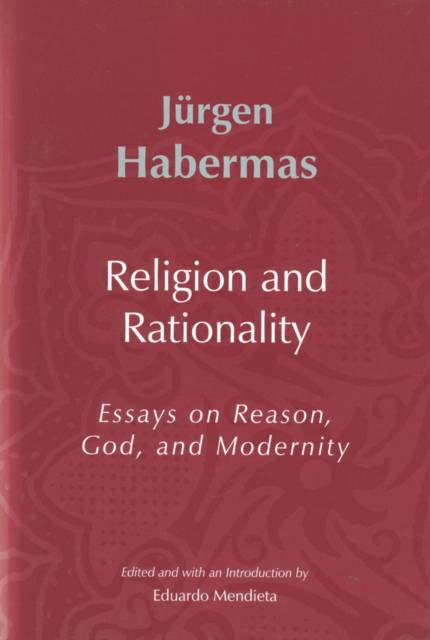
This important new volume brings together Habermas' key writing on religion and religious belief. Habermas explores the relations between Christian and Jewish thought, on the one hand, and the Western philosophical tradition on the other. In so doing, he examines a range of important figures, including Benjamin, Heidegger, Johann Baptist Metz and Gershom Scholem.
In a new introduction written especially for this volume, Eduardo Mendieta places Habermas' engagement with religion in the context of his work as a whole. Mendieta also discusses Habermas' writings in relation to Jewish Messianism and the Frankfurt School, showing how the essays in Religion and Rationality, one of which is translated into English for the first time, foreground an important, yet often neglected, dimension of critical theory. The volume concludes with an original extended interview, also in English for the first time, in which Habermas develops his current views on religion in modern society.
This book will be of great interest to students and scholars in theology, religious studies and philosophy, as well as to all those already familiar with Habermas' work.
In a new introduction written especially for this volume, Eduardo Mendieta places Habermas' engagement with religion in the context of his work as a whole. Mendieta also discusses Habermas' writings in relation to Jewish Messianism and the Frankfurt School, showing how the essays in Religion and Rationality, one of which is translated into English for the first time, foreground an important, yet often neglected, dimension of critical theory. The volume concludes with an original extended interview, also in English for the first time, in which Habermas develops his current views on religion in modern society.
This book will be of great interest to students and scholars in theology, religious studies and philosophy, as well as to all those already familiar with Habermas' work.
Specificaties
Betrokkenen
- Auteur(s):
- Uitgeverij:
Inhoud
- Aantal bladzijden:
- 184
- Taal:
- Engels
- Reeks:
Eigenschappen
- Productcode (EAN):
- 9780745624877
- Verschijningsdatum:
- 24/06/2002
- Uitvoering:
- Paperback
- Formaat:
- Trade paperback (VS)
- Afmetingen:
- 155 mm x 228 mm
- Gewicht:
- 281 g


Alleen bij Standaard Boekhandel
+ 58 punten op je klantenkaart van Standaard Boekhandel
Cadeau

AANGERADEN


Beoordelingen
We publiceren alleen reviews die voldoen aan de voorwaarden voor reviews. Bekijk onze voorwaarden voor reviews.