


- Afhalen na 1 uur in een winkel met voorraad
- Gratis thuislevering in België vanaf € 30
- Ruim aanbod met 7 miljoen producten
- Afhalen na 1 uur in een winkel met voorraad
- Gratis thuislevering in België vanaf € 30
- Ruim aanbod met 7 miljoen producten





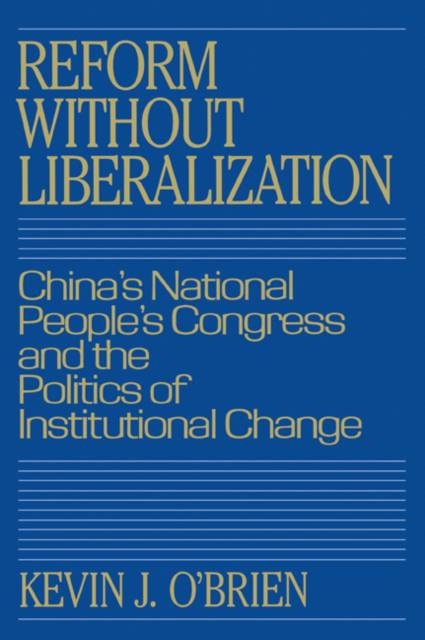
Reform Without Liberalization
China's National People's Congress and the Politics of Institutional Change
Kevin J O'Brien
Paperback | Engels
€ 60,95
+ 121 punten
Uitvoering
Omschrijving
Since its founding in 1954, the National People's Congress of China (NPC) has followed a difficult course of development, a course which has been characterized by periods of limited progress intermingled with periods of stagnation and regression. Political campaigns from the Anti-Rightist Movement (1957-1958) to the Great Leap Forward (1958-1960) to the Cultural Revolution (1966-1976) frustrated the establishment of any consistent policy concerning the appropriate role of the legislature within the one-party, Maoist regime. Mao's death in 1976, however, ushered in a new era of political reform which has included the strengthening of the NPC. In this first detailed study of the NPC, Kevin O'Brien examines how the NPC has changed from its founding under Mao through the regime of Deng Xiaoping. He describes the various functions it has served, from the management of intra-elite relations; to the incorporation, and co-optation, of criticisms of regime policies into regime debates; to legislation and supervision of government agencies. The author concludes that although the NPC has not moved toward liberalization, meaning movement toward political autonomy and direct representation of citizen interests, increased legislative involvement in lawmaking, oversight and regime support indicates that the NPC is developing an expanded, more powerful role in the political system.
Specificaties
Betrokkenen
- Auteur(s):
- Uitgeverij:
Inhoud
- Aantal bladzijden:
- 280
- Taal:
- Engels
Eigenschappen
- Productcode (EAN):
- 9780521048200
- Verschijningsdatum:
- 3/01/2008
- Uitvoering:
- Paperback
- Formaat:
- Trade paperback (VS)
- Afmetingen:
- 152 mm x 229 mm
- Gewicht:
- 412 g


Alleen bij Standaard Boekhandel
+ 121 punten op je klantenkaart van Standaard Boekhandel

Beoordelingen
We publiceren alleen reviews die voldoen aan de voorwaarden voor reviews. Bekijk onze voorwaarden voor reviews.