


- Afhalen na 1 uur in een winkel met voorraad
- Gratis thuislevering in België vanaf € 30
- Ruim aanbod met 7 miljoen producten
- Afhalen na 1 uur in een winkel met voorraad
- Gratis thuislevering in België vanaf € 30
- Ruim aanbod met 7 miljoen producten





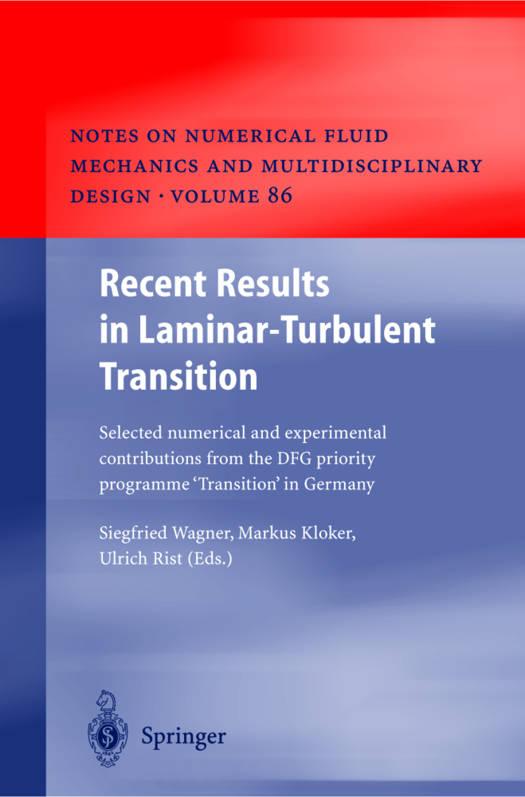
Recent Results in Laminar-Turbulent Transition
Selected Numerical and Experimental Contributions from the Dfg Priority Programme Transition in Germany
€ 349,45
+ 698 punten
Omschrijving
Methodic investigations of laminar-turbulent transition in wall-bounded she- ar flows under controlled conditions are essential for untangling the various complex phenomena of the transition process occurring in flows at practical conditions. They allow understanding of the instability processes of the la- minar flow, and thus enable the development of tools for flow control. On the one hand the laminar flow regime can be extended by delaying transition to reduce viscous drag, and on the other hand large-scale flow disturbances or transition can be forced in order to enhance momentum and mass ex- change. Thus flow separation can be prevented, or mixing of fuel and air in combustion engines enhanced, for instance. The "DFG Verbund-Schwerpunktprogramm Transition" - a cooperative priority research program of universities, research establishments and indu- stry in Germany - has been launched in April 1996 with the aim to explore transition by a coordinated use, development and validation of advanced experimental techniques and theoretical/numerical simulation methods, bin- ding together all the appropriate resources available in Germany. At the very beginning of the six-year research period specifically selected test problems were to be investigated by various theoretical and experimental methods to identify and possibly rule out inadequate numerical or experimental methods. With respect to experiments it was planned to use multi-sensor-surface measuring techniques, the infrared measuring technique, and particle image velocimetry (PlV) in addition to hot-wire techniques to get instantaneous images of flows in sections, on surfaces, or within the complete flow field.
Specificaties
Betrokkenen
- Uitgeverij:
Inhoud
- Aantal bladzijden:
- 324
- Taal:
- Engels
- Reeks:
- Reeksnummer:
- nr. 86
Eigenschappen
- Productcode (EAN):
- 9783540404903
- Verschijningsdatum:
- 11/09/2003
- Uitvoering:
- Hardcover
- Formaat:
- Genaaid
- Afmetingen:
- 156 mm x 234 mm
- Gewicht:
- 657 g

Alleen bij Standaard Boekhandel
+ 698 punten op je klantenkaart van Standaard Boekhandel
Cadeau

AANGERADEN


Beoordelingen
We publiceren alleen reviews die voldoen aan de voorwaarden voor reviews. Bekijk onze voorwaarden voor reviews.