


- Afhalen na 1 uur in een winkel met voorraad
- Gratis thuislevering in België vanaf € 30
- Ruim aanbod met 7 miljoen producten
- Afhalen na 1 uur in een winkel met voorraad
- Gratis thuislevering in België vanaf € 30
- Ruim aanbod met 7 miljoen producten





€ 151,45
+ 302 punten
Omschrijving
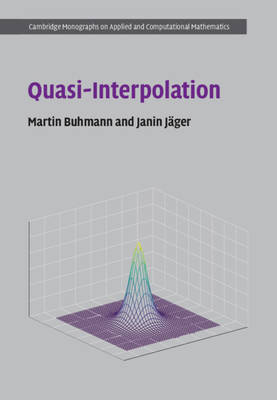
Quasi-interpolation is one of the most useful and often applied methods for the approximation of functions and data in mathematics and applications. Its advantages are manifold: quasi-interpolants are able to approximate in any number of dimensions, they are efficient and relatively easy to formulate for scattered and meshed nodes and for any number of data. This book provides an introduction into the field for graduate students and researchers, outlining all the mathematical background and methods of implementation. The mathematical analysis of quasi-interpolation is given in three directions, namely on the basis (spline spaces, radial basis functions) from which the approximation is taken, on the form and computation of the quasi-interpolants (point evaluations, averages, least squares), and on the mathematical properties (existence, locality, convergence questions, precision). Learn which type of quasi-interpolation to use in different contexts and how to optimise its features to suit applications in physics and engineering.
Specificaties
Betrokkenen
- Auteur(s):
- Uitgeverij:
Inhoud
- Aantal bladzijden:
- 290
- Taal:
- Engels
- Reeks:
- Reeksnummer:
- nr. 37
Eigenschappen
- Productcode (EAN):
- 9781107072633
- Verschijningsdatum:
- 3/03/2022
- Uitvoering:
- Hardcover
- Formaat:
- Genaaid
- Afmetingen:
- 170 mm x 244 mm
- Gewicht:
- 662 g


Alleen bij Standaard Boekhandel
+ 302 punten op je klantenkaart van Standaard Boekhandel
Cadeau

AANGERADEN


Beoordelingen
We publiceren alleen reviews die voldoen aan de voorwaarden voor reviews. Bekijk onze voorwaarden voor reviews.