


- Afhalen na 1 uur in een winkel met voorraad
- Gratis thuislevering in België vanaf € 30
- Ruim aanbod met 7 miljoen producten
- Afhalen na 1 uur in een winkel met voorraad
- Gratis thuislevering in België vanaf € 30
- Ruim aanbod met 7 miljoen producten





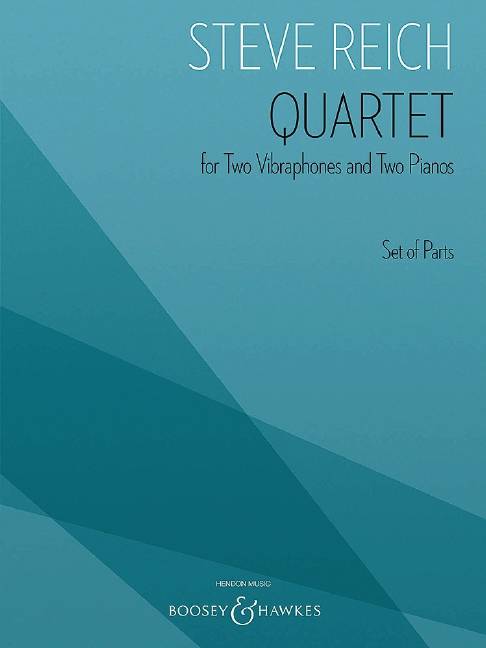
Omschrijving
Composer's note:
'Quartet', when mentioned in the context of concert music, is generally assumed to mean 'string quartet'. In my case, the quartet hat has played a central role in many of my pieces (besides the string quartet) is that of two pianos and two percussion. It appears like that, or in expanded form with more pianos or more percussion, in The Desert Music, Sextet, Three Movements, The Four Sections, The Cave, Dance Patterns, Three Tales, You Are (Variations), Variations for Vibes, Pianos and Strings, Daniel Variations, Double Sextet, and Radio Rewrite . In Quartet, there is just this group alone: two vibes and two pianos.
The piece is one of the more complex I have composed. It frequently changes key and often breaks off continuity to pause or take up new material. Though the parts are not unduly difficult, it calls for a high level of ensemble virtuosity.
The form is one familiar throughout history: fast, slow, fast, played without pause. The slow movement introduces harmonies not usually found in my music."
Instrumentation:
2 vibraphones and 2 piano
'Quartet', when mentioned in the context of concert music, is generally assumed to mean 'string quartet'. In my case, the quartet hat has played a central role in many of my pieces (besides the string quartet) is that of two pianos and two percussion. It appears like that, or in expanded form with more pianos or more percussion, in The Desert Music, Sextet, Three Movements, The Four Sections, The Cave, Dance Patterns, Three Tales, You Are (Variations), Variations for Vibes, Pianos and Strings, Daniel Variations, Double Sextet, and Radio Rewrite . In Quartet, there is just this group alone: two vibes and two pianos.
The piece is one of the more complex I have composed. It frequently changes key and often breaks off continuity to pause or take up new material. Though the parts are not unduly difficult, it calls for a high level of ensemble virtuosity.
The form is one familiar throughout history: fast, slow, fast, played without pause. The slow movement introduces harmonies not usually found in my music."
Instrumentation:
2 vibraphones and 2 piano
Specificaties
Betrokkenen
- Uitgeverij:
Inhoud
- Aantal bladzijden:
- 76
- Taal:
- Engels
Eigenschappen
- Productcode (EAN):
- 9781540028242
- Verschijningsdatum:
- 1/07/2018
- Uitvoering:
- Paperback
- Formaat:
- Trade paperback (VS)
- Afmetingen:
- 229 mm x 305 mm
- Gewicht:
- 317 g

Alleen bij Standaard Boekhandel
+ 93 punten op je klantenkaart van Standaard Boekhandel
Cadeau

AANGERADEN


Beoordelingen
We publiceren alleen reviews die voldoen aan de voorwaarden voor reviews. Bekijk onze voorwaarden voor reviews.