


- Afhalen na 1 uur in een winkel met voorraad
- Gratis thuislevering in België vanaf € 30
- Ruim aanbod met 7 miljoen producten
- Afhalen na 1 uur in een winkel met voorraad
- Gratis thuislevering in België vanaf € 30
- Ruim aanbod met 7 miljoen producten





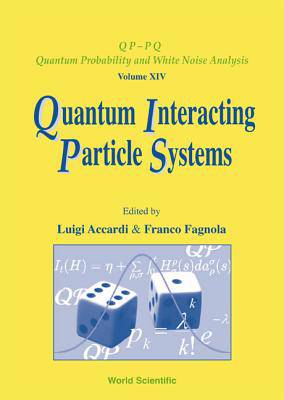
Quantum Interacting Particle Systems
€ 167,95
Omschrijving
The problem of extending ideas and results on the dynamics of infinite classical lattice systems to the quantum domain naturally arises in different branches of physics (nonequilibrium statistical mechanics, quantum optics, solid state, ...) and new momentum from the development of quantum computer and quantum neural networks (which are in fact interacting arrays of binary systems) has been found.The stochastic limit of quantum theory allowed to deduce, as limits of the usual Hamiltonian systems, a new class of quantum stochastic flows which, when restricted to an appropriate Abelian subalgebra, produces precisely those interacting particle systems studied in classical statistical mechanics.Moreover, in many interesting cases, the underlying classical process "drives" the quantum one, at least as far as ergodicity or convergence to equilibrium are concerned. Thus many deep results concerning classical systems can be directly applied to carry information on the corresponding quantum system. The thermodynamic limit itself is obtained thanks to a technique (the four-semigroup method, new even in the classical case) which reduces the infinitesimal structure of a stochastic flow to that of four semigroups canonically associated to it (Chap. 1).Simple and effective methods to analyze qualitatively the ergodic behavior of quantum Markov semigroups are discussed in Chap. 2.Powerful estimates used to control the infinite volume limit, ergodic behavior and the spectral gap (Gaussian, exponential and hypercontractive bounds, classical and quantum logarithmic Sobolev inequalities, ...) are discussed in Chap. 3.
Specificaties
Betrokkenen
- Uitgeverij:
Inhoud
- Aantal bladzijden:
- 356
- Taal:
- Engels
- Reeks:
- Reeksnummer:
- nr. 14
Eigenschappen
- Productcode (EAN):
- 9789812381040
- Verschijningsdatum:
- 22/07/2002
- Uitvoering:
- Hardcover
- Formaat:
- Genaaid

Alleen bij Standaard Boekhandel
Cadeau

AANGERADEN


Beoordelingen
We publiceren alleen reviews die voldoen aan de voorwaarden voor reviews. Bekijk onze voorwaarden voor reviews.