


- Afhalen na 1 uur in een winkel met voorraad
- Gratis thuislevering in België vanaf € 30
- Ruim aanbod met 7 miljoen producten
- Afhalen na 1 uur in een winkel met voorraad
- Gratis thuislevering in België vanaf € 30
- Ruim aanbod met 7 miljoen producten





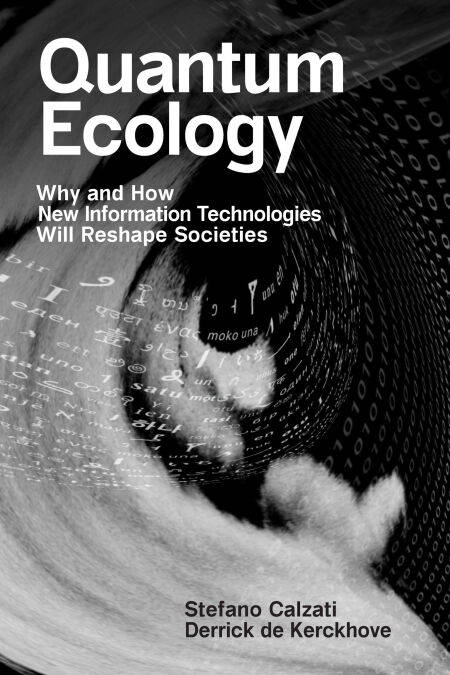
Quantum Ecology E-BOOK
Why and How New Information Technologies Will Reshape Societies
Stefano Calzati, Derrick De Kerckhove
E-book | Engels
€ 44,35
+ 44 punten
Omschrijving
An exploration of the emerging quantum technological paradigm and its effects on human consciousness and cultures.
In Quantum Ecology, Stefano Calzati and Derrick de Kerckhove identify three technological ecologies—linguistic, digital, and quantum—to better understand today’s shattered globalized contemporaneity and navigate the impact of soon-to-come quantum information technologies. Today’s societies, based as they are on language and writing, face disruption brought on by digital transformation, which is not predicated on sharing meaning but on sheer computability. This produces what the authors call an “epistemological crisis.” From here, the book explores how emerging quantum computers and communication will trigger an even deeper existential shift based on quantum physics’ principles of discreteness, uncertainty, and entanglement.
Enriched with evidence from biology, anthropology, sociolinguistics, and information and cognitive sciences, the authors draw upon diverse case studies to sustain a convincing philosophical and political argument. The book’s chapters move from a discussion about the coevolution of humans and language to the codependence of writing, thinking, and innovation, then proceed to investigate “datacracy,” the power of algorithms. Finally, the authors outline the looming psychocultural effects and geopolitical challenges of the nascent quantum technological paradigm.
In Quantum Ecology, Stefano Calzati and Derrick de Kerckhove identify three technological ecologies—linguistic, digital, and quantum—to better understand today’s shattered globalized contemporaneity and navigate the impact of soon-to-come quantum information technologies. Today’s societies, based as they are on language and writing, face disruption brought on by digital transformation, which is not predicated on sharing meaning but on sheer computability. This produces what the authors call an “epistemological crisis.” From here, the book explores how emerging quantum computers and communication will trigger an even deeper existential shift based on quantum physics’ principles of discreteness, uncertainty, and entanglement.
Enriched with evidence from biology, anthropology, sociolinguistics, and information and cognitive sciences, the authors draw upon diverse case studies to sustain a convincing philosophical and political argument. The book’s chapters move from a discussion about the coevolution of humans and language to the codependence of writing, thinking, and innovation, then proceed to investigate “datacracy,” the power of algorithms. Finally, the authors outline the looming psychocultural effects and geopolitical challenges of the nascent quantum technological paradigm.
Specificaties
Betrokkenen
- Auteur(s):
- Uitgeverij:
Inhoud
- Aantal bladzijden:
- 288
- Taal:
- Engels
Eigenschappen
- Productcode (EAN):
- 9780262375412
- Verschijningsdatum:
- 11/11/2024
- Uitvoering:
- E-book
- Beveiligd met:
- Adobe DRM
- Formaat:
- ePub


Alleen bij Standaard Boekhandel
+ 44 punten op je klantenkaart van Standaard Boekhandel
CADEAU


Beoordelingen
We publiceren alleen reviews die voldoen aan de voorwaarden voor reviews. Bekijk onze voorwaarden voor reviews.