


- Afhalen na 1 uur in een winkel met voorraad
- Gratis thuislevering in België vanaf € 30
- Ruim aanbod met 7 miljoen producten
- Afhalen na 1 uur in een winkel met voorraad
- Gratis thuislevering in België vanaf € 30
- Ruim aanbod met 7 miljoen producten





€ 129,95
+ 259 punten
Omschrijving
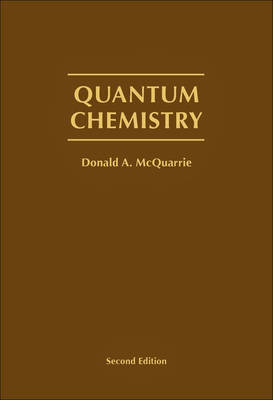
Quantum Chemistry 2e offers students a superb introduction to quantum mechanics and its application to chemistry
Still a best-selling text after a remarkable twenty-four years in print, Don McQuarrie has updated his landmark Quantum Chemistry into a keenly anticipated second edition. Perhaps the biggest change in the years since the first edition appeared is the proliferation of computational chemistry programs that are available to calculate molecular properties. McQuarrie has presented step-by-step SCF calculations of a helium atom in Chapter 9 and a hydrogen molecule in Chapter 10, in addition to including an entire chapter on the Hartree-Fock method and post-Hartree-Fock methods for the calculation of molecular properties. Most molecular calculations nowadays use Gaussian orbitals, and they are introduced here along with the common notation such as HF / STO-6G and HF / 6-31G** to describe the types of calculations involving Gaussian orbitals. The final sections discuss configuration interaction, coupled-cluster theory and density functional theory, at least semi-quantitatively, so that the reader can be aware of the computational methods that are being used currently. Terminology such as CISD, CCSD, and BLPY / 6-31G* is introduced and hands-on molecular calculations for all these methods using computational chemistry programs such as Gaussian and WebMo for a variety of molecules is presented. The book also uses problems to encourage the use of an invaluable National Institute of Science and Technology ( NIST ) website that lists experimental data and the results of various ab initio calculations for hundreds of molecules.Other changes include the discussion of molecular spectroscopy throughout the chapters on the harmonic oscillator and the rigid-rotator. The hydrogen atom, along with its electronic spectroscopy, is discussed in a separate chapter. And in the following chapter, which is devoted entirely to multielectron atoms, a website for Hartree-Fock atomic orbitals is introduced. After learning the structure of these atomic orbitals, they are used to calculate atomic properties for multielectron atoms.The new edition also includes a series of short interchapters called MathChapters placed throughout the book to help students focus on the physical principles being explained rather than struggling with the underlying mathematics. As with the first edition, the book assumes a prerequisite of one year of calculus with no required knowledge of differential equations. Each chapter includes a broad range of problems and exercises.Translated into Korean.
Still a best-selling text after a remarkable twenty-four years in print, Don McQuarrie has updated his landmark Quantum Chemistry into a keenly anticipated second edition. Perhaps the biggest change in the years since the first edition appeared is the proliferation of computational chemistry programs that are available to calculate molecular properties. McQuarrie has presented step-by-step SCF calculations of a helium atom in Chapter 9 and a hydrogen molecule in Chapter 10, in addition to including an entire chapter on the Hartree-Fock method and post-Hartree-Fock methods for the calculation of molecular properties. Most molecular calculations nowadays use Gaussian orbitals, and they are introduced here along with the common notation such as HF / STO-6G and HF / 6-31G** to describe the types of calculations involving Gaussian orbitals. The final sections discuss configuration interaction, coupled-cluster theory and density functional theory, at least semi-quantitatively, so that the reader can be aware of the computational methods that are being used currently. Terminology such as CISD, CCSD, and BLPY / 6-31G* is introduced and hands-on molecular calculations for all these methods using computational chemistry programs such as Gaussian and WebMo for a variety of molecules is presented. The book also uses problems to encourage the use of an invaluable National Institute of Science and Technology ( NIST ) website that lists experimental data and the results of various ab initio calculations for hundreds of molecules.Other changes include the discussion of molecular spectroscopy throughout the chapters on the harmonic oscillator and the rigid-rotator. The hydrogen atom, along with its electronic spectroscopy, is discussed in a separate chapter. And in the following chapter, which is devoted entirely to multielectron atoms, a website for Hartree-Fock atomic orbitals is introduced. After learning the structure of these atomic orbitals, they are used to calculate atomic properties for multielectron atoms.The new edition also includes a series of short interchapters called MathChapters placed throughout the book to help students focus on the physical principles being explained rather than struggling with the underlying mathematics. As with the first edition, the book assumes a prerequisite of one year of calculus with no required knowledge of differential equations. Each chapter includes a broad range of problems and exercises.Translated into Korean.
Specificaties
Betrokkenen
- Auteur(s):
- Uitgeverij:
Inhoud
- Aantal bladzijden:
- 704
- Taal:
- Engels
Eigenschappen
- Productcode (EAN):
- 9781891389504
- Verschijningsdatum:
- 31/10/2007
- Uitvoering:
- Hardcover
- Formaat:
- Genaaid
- Afmetingen:
- 175 mm x 262 mm
- Gewicht:
- 1315 g


Alleen bij Standaard Boekhandel
+ 259 punten op je klantenkaart van Standaard Boekhandel
Cadeau

AANGERADEN


Beoordelingen
We publiceren alleen reviews die voldoen aan de voorwaarden voor reviews. Bekijk onze voorwaarden voor reviews.