


- Afhalen na 1 uur in een winkel met voorraad
- Gratis thuislevering in België vanaf € 30
- Ruim aanbod met 7 miljoen producten
- Afhalen na 1 uur in een winkel met voorraad
- Gratis thuislevering in België vanaf € 30
- Ruim aanbod met 7 miljoen producten





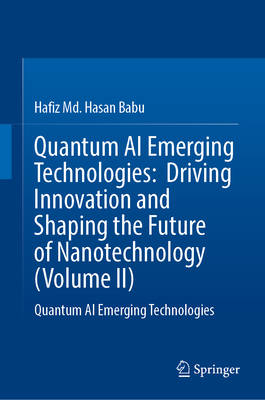
Quantum AI Emerging Technologies: Driving Innovation and Shaping the Future of Nanotechnology (Volume II)
Quantum AI Emerging Technologies
Hafiz MD Hasan Babu
Hardcover | Engels
€ 152,95
+ 305 punten
Omschrijving
The book is designed to serve as a comprehensive guide for both researchers and professionals interested in exploring the transformative impact of quantum computing and AI on VLSI circuits and embedded systems. As the boundaries of computational science continue to expand, Volume II Quantum AI Emerging Technologies turns its focus to where theory meets application--where the conceptual foundation laid in Volume I is transformed into practical, system-level innovations. This volume explores how quantum computing and artificial intelligence are revolutionizing key technological domains, ranging from robotics and cloud computing to cybersecurity, neuromorphic computing, smart city, IoT, blockchain, nuclear engineering, big data analytics, human-computer interaction, image processing, and healthcare. It also covers a wide range of topics, from the basic definitions and principles of quantum circuits to advanced architectures for integrating quantum and classical systems. Each chapter provides a deep dive into specific aspects of quantum computing's influence on hardware design, including quantum machine learning for VLSI placement, the development of quantum integrated circuits, and the design of quantum enhanced embedded systems, etc. In addition, Volume II considers many other challenging topics in our real-life to resolve practical problems by quantum AI which are not usually available. This book aims to serve as a roadmap for the present and future of quantum-AI integration. It is intended to inform not just researchers and engineers, but also educators, entrepreneurs, and policymakers. The journey of intelligent quantum systems has only just begun, and it is one that will shape the future of computation, society, and the planet.
Specificaties
Betrokkenen
- Auteur(s):
- Uitgeverij:
Inhoud
- Aantal bladzijden:
- 1635
- Taal:
- Engels
Eigenschappen
- Productcode (EAN):
- 9789819599332
- Verschijningsdatum:
- 22/08/2026
- Uitvoering:
- Hardcover
- Formaat:
- Genaaid
- Afmetingen:
- 155 mm x 235 mm


Alleen bij Standaard Boekhandel
+ 305 punten op je klantenkaart van Standaard Boekhandel
Cadeau

AANGERADEN


Beoordelingen
We publiceren alleen reviews die voldoen aan de voorwaarden voor reviews. Bekijk onze voorwaarden voor reviews.