


- Afhalen na 1 uur in een winkel met voorraad
- Gratis thuislevering in België vanaf € 30
- Ruim aanbod met 7 miljoen producten
- Afhalen na 1 uur in een winkel met voorraad
- Gratis thuislevering in België vanaf € 30
- Ruim aanbod met 7 miljoen producten





Omschrijving
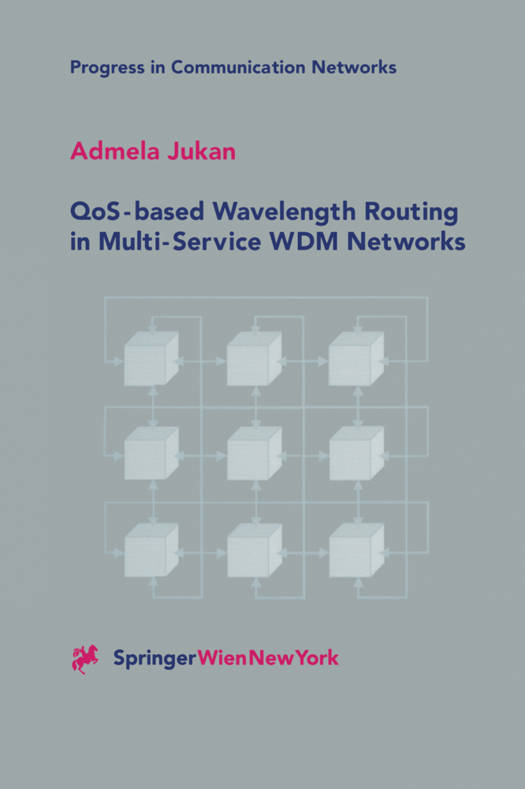
The need to establish wavelength-routed connections in a service-differentiated fash- ion is becoming increasingly important due to a variety of candidate client networks (e. g. IP, SDH/SONET, ATM) and the requirements for Quality-of-Service (QoS) de- livery within transport layers. Up until now, the criteria for optical network design and operation have usually been considered independently of the higher-layer client signals (users), i. e. without taking into account particular requirements or constraints originating from the users' differentiation. Wavelength routing for multi-service net- works with performance guarantees, however, will have to do with much more than finding a path and allocating wavelengths. The optimisation of wavelength-routed paths will have to take into account a number of user requirements and network con- straints, while keeping the resource utilisation and blocking probability as low as pos- sible. In a networking scenario where a multi-service operation in WDM networks is assumed, while dealing with heterogeneous architectures (e. g. technology-driven, as transparent, or regenerative), efficient algorithms and protocols for QoS-differentiated and dynamic allocation of physical resources will playa key role. This work examines the development of multi-criteria wavelength routing for WDM networks where a set of performances is guaranteed to each client network, taking into account network properties and physical constraints.
Specificaties
Betrokkenen
- Auteur(s):
- Uitgeverij:
Inhoud
- Aantal bladzijden:
- 244
- Taal:
- Engels
- Reeks:
- Reeksnummer:
- nr. 1
Eigenschappen
- Productcode (EAN):
- 9783211836255
- Verschijningsdatum:
- 26/02/2001
- Uitvoering:
- Hardcover
- Formaat:
- Genaaid
- Afmetingen:
- 169 mm x 247 mm
- Gewicht:
- 621 g



Alleen bij Standaard Boekhandel
+ 279 punten op je klantenkaart van Standaard Boekhandel
CADEAU


Beoordelingen
We publiceren alleen reviews die voldoen aan de voorwaarden voor reviews. Bekijk onze voorwaarden voor reviews.