


- Afhalen na 1 uur in een winkel met voorraad
- Gratis thuislevering in België vanaf € 30
- Ruim aanbod met 7 miljoen producten
- Afhalen na 1 uur in een winkel met voorraad
- Gratis thuislevering in België vanaf € 30
- Ruim aanbod met 7 miljoen producten





€ 40,92
+ 81 punten
Omschrijving
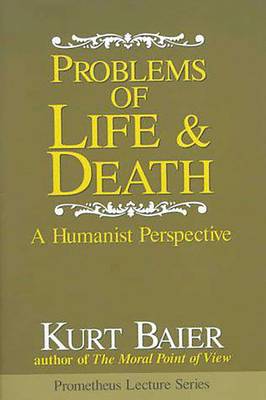
Noted scholar and humanist argues that we can find answers to important human questions without recourse to faith in a supernatural deity.
What gives purpose to our existence? What happens to our mind and body when we die? What invests our lives with meaning and propels us to go on from day to day? These are some of the questions that have occupied humankind for centuries. Do solutions to these problems of life and death depend, as many believe, on the existence and intervention of a supernatural creator god? In this contribution to the Prometheus Lecture Series, noted scholar and humanist Kurt Baier, one of the leading ethical theorists of the 20th century, contends that rational humanism is the best alternative to theism.
In Problems of Life & Death: A Humanist Perspective, he offers a lively discussion of humanism and supernaturalism; problems of practical wisdom featuring death and the good; and traditional moral problems. Part one traces contemporary rational humanism to its roots in ancient Greece; its revival in the Christian renaissance; its development during the scientific revolution, the 18th century Enlightenment, the Darwinian theory of evolution, and its contemporary developments. Part two answers broad questions of practical wisdom from the rationalist point of view. The third part offers a rationalist conception of morality to replace "the will of God" as the impetus for human action. Baier then applies this moral stance to a number of contemporary moral problems including how to lead a rewarding life, homosexual behavior, birth control, and suicide. With fresh ideas, a carefully argued thesis, and convincing conclusions, Baier shows how the rational humanist can come to grips with some of the deepest problems of human existence, without assumptions based on religious faith.
What gives purpose to our existence? What happens to our mind and body when we die? What invests our lives with meaning and propels us to go on from day to day? These are some of the questions that have occupied humankind for centuries. Do solutions to these problems of life and death depend, as many believe, on the existence and intervention of a supernatural creator god? In this contribution to the Prometheus Lecture Series, noted scholar and humanist Kurt Baier, one of the leading ethical theorists of the 20th century, contends that rational humanism is the best alternative to theism.
In Problems of Life & Death: A Humanist Perspective, he offers a lively discussion of humanism and supernaturalism; problems of practical wisdom featuring death and the good; and traditional moral problems. Part one traces contemporary rational humanism to its roots in ancient Greece; its revival in the Christian renaissance; its development during the scientific revolution, the 18th century Enlightenment, the Darwinian theory of evolution, and its contemporary developments. Part two answers broad questions of practical wisdom from the rationalist point of view. The third part offers a rationalist conception of morality to replace "the will of God" as the impetus for human action. Baier then applies this moral stance to a number of contemporary moral problems including how to lead a rewarding life, homosexual behavior, birth control, and suicide. With fresh ideas, a carefully argued thesis, and convincing conclusions, Baier shows how the rational humanist can come to grips with some of the deepest problems of human existence, without assumptions based on religious faith.
Specificaties
Betrokkenen
- Auteur(s):
- Uitgeverij:
Inhoud
- Aantal bladzijden:
- 233
- Taal:
- Engels
- Reeks:
Eigenschappen
- Productcode (EAN):
- 9781573921534
- Verschijningsdatum:
- 1/09/1997
- Uitvoering:
- Hardcover
- Formaat:
- Genaaid
- Afmetingen:
- 160 mm x 238 mm
- Gewicht:
- 485 g


Alleen bij Standaard Boekhandel
+ 81 punten op je klantenkaart van Standaard Boekhandel
Cadeau

AANGERADEN


Beoordelingen
We publiceren alleen reviews die voldoen aan de voorwaarden voor reviews. Bekijk onze voorwaarden voor reviews.